

Address client concerns during a project by identifying the specific uncertainty, checking it against the work and agreements, and choosing a useful response. The client may need clearer information, a delivery correction, a decision, or a revised plan.
Here, client confidence means their current belief that the project is being handled competently and that they understand the next step. It is not a validated score or a prediction of renewal.
A green dashboard does not establish how the client feels. A worried question does not prove the project is failing. Ask what remains unclear, then act on the answer.
Separate confidence from satisfaction
A client can be satisfied with a completed deliverable but uncertain about the next stage. They can also feel reassured by regular communication while the work itself needs correction.
For that reason, ask about the specific situation rather than treating one general rating as a complete account of the relationship.
Compare:
- “Are you happy with everything?”
- “Is the next review and what you need to do for it clear?”
The second question gives the client a concrete subject to discuss. It does not replace questions about quality, suitability, or satisfaction; it serves a different purpose.
Look for uncertainty without assigning motives
Repeated questions, delayed replies, and new stakeholder involvement can have several explanations.
| Observable signal | Possible explanations | Useful next question |
|---|---|---|
| Client repeatedly asks about the launch date | They missed the update, the date is unclear, or an external event changed | “Is the current launch position clear, or is there a new timing requirement?” |
| Client stops responding | Workload, absence, unclear request, shifting priority, or concern | “Is the review request workable, or do we need to adjust the next step?” |
| Client adds another reviewer | Normal governance, expertise needed, or unresolved uncertainty | “What does the additional reviewer need to assess, and who will confirm the final decision?” |
| Client asks for more detail | They need internal reporting, are unfamiliar with the work, or doubt an explanation | “Which part needs more detail for your decision?” |
None of these signals proves declining trust. Treat them as reasons to clarify, not as secret indicators you can interpret with certainty.
Ask questions that can produce an action
Use a few relevant questions at milestones or when uncertainty appears:
- “Is it clear what is complete and what still needs approval?”
- “What part of the next stage feels uncertain?”
- “Do you have what you need to explain the project internally?”
- “Is there a concern we have not addressed yet?”
Do not ask all of them at every meeting. Choose the question that fits the current situation and make space for an answer you might not like.
If you collect ratings, explain the scale and use them as contextual feedback. A score of seven is not a churn probability, and a change in score is not meaningful without understanding what changed for that client.
A misunderstood commitment may need you to revisit the expectation agreement, rather than offer reassurance.
Match the response to the actual concern
Use a short sequence: Listen → Clarify → Verify → Respond → Agree next step → Follow up. Listen to the specific concern, clarify the disputed point, and verify it against the work and original commitment before choosing a response. Record what will resolve it and check that result; sending an explanation alone does not close the concern.
If the concern is visibility, explain the current position and where supporting information can be found.
If the concern is a misunderstood commitment, compare the interpretations and resolve the ambiguity fairly.
If the concern is a real quality problem, investigate and correct it. A clearer update cannot compensate for work that fails the agreement.
If the concern is an uncertain outcome, explain what is known, what remains open, and the next check. Do not offer certainty the evidence does not support.
If priorities changed, reconsider the plan. Keeping the old project moving efficiently may no longer serve the client.
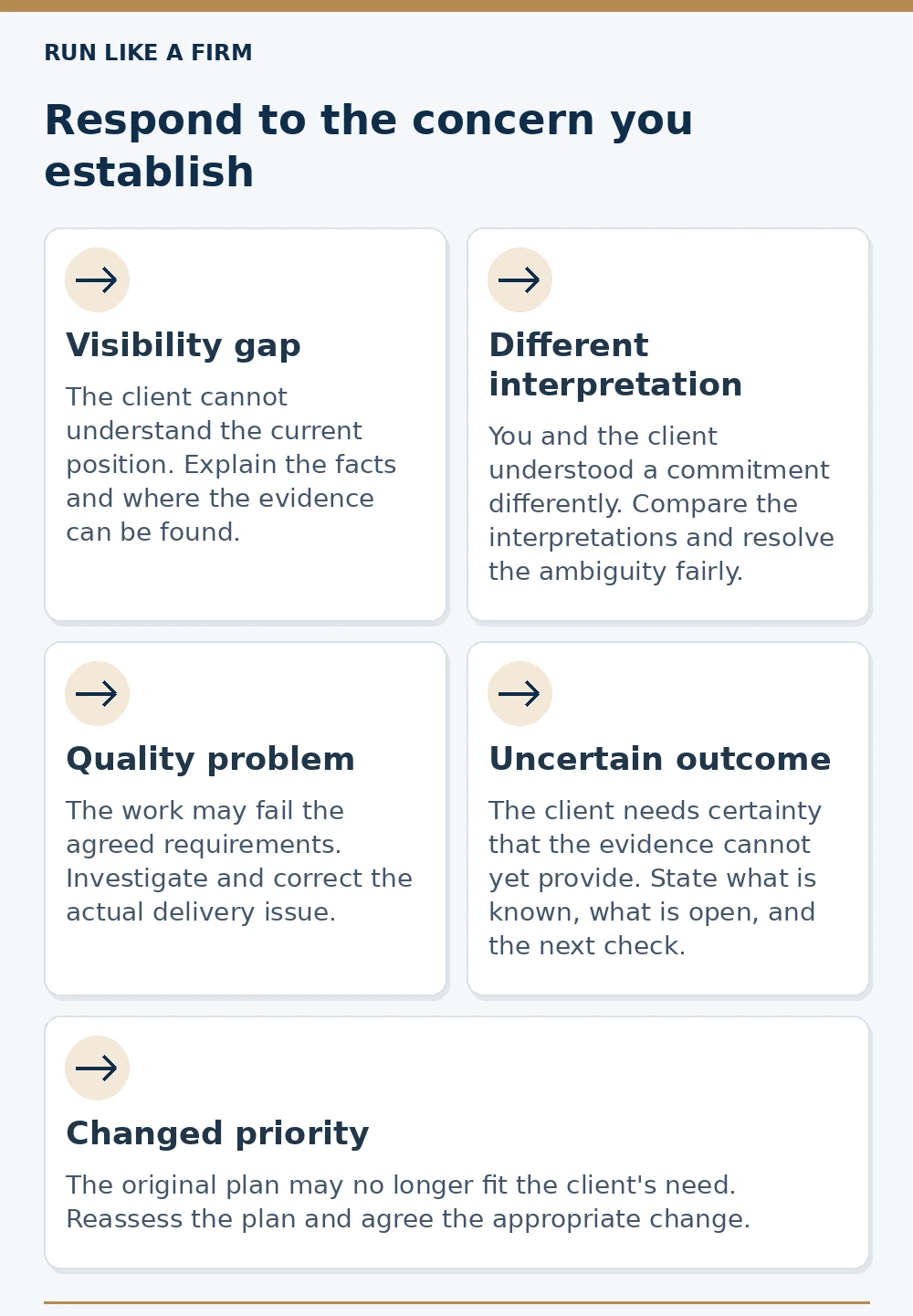
Read the decision map as text
- Visibility gap: The client cannot understand the current position. Explain the facts and where the evidence can be found.
- Different interpretation: You and the client understood a commitment differently. Compare the interpretations and resolve the ambiguity fairly.
- Quality problem: The work may fail the agreed requirements. Investigate and correct the actual delivery issue.
- Uncertain outcome: The client needs certainty that the evidence cannot yet provide. State what is known, what is open, and the next check.
- Changed priority: The original plan may no longer fit the client's need. Reassess the plan and agree the appropriate change.
Ask what is unclear before interpreting a signal as lost trust. A concern is not a churn probability. Record the specific action and follow-up point.
A worked milestone conversation
Imagine a fictional design engagement. The project is on schedule, but the client keeps asking whether the next presentation will be “final.”
The designer initially interprets this as impatience. A clarification reveals that the client must show the work to a director and is unsure what decisions are still open.
The useful response is specific:
The next presentation is the direction review, not the final deliverable. It will show the recommended approach and the choices we need confirmed. Once that direction is approved, I will produce the final version. I can include a short summary explaining that sequence for the director.
The designer sends the sequence summary and checks whether the client can now identify the presentation’s purpose and next approval. The client confirms the sequence is clear. That closes this particular information question; it does not prove a wider relationship outcome.
In another engagement, the repeated question could reveal a genuine deadline conflict. The same observable signal can lead to a different action.
A justified quality complaint needs a checked correction
Hypothetical second case: the agreed inquiry-routing test requires submissions to reach the operations inbox. The client reports a missing test inquiry. The provider listens without dismissing it as nervousness, asks for the route/time and test identifier, then reproduces the failure under the agreed conditions. The delivered configuration has not met its commitment.
- Concern / evidence
- Test Q1 through the service-page route on October 29, 2026 shows confirmation but no operations receipt. Client’s report and the provider’s repeat check are linked.
- Original commitment
- Approved scope v1 requires the named route to reach the operations inbox with the agreed fields under recorded test conditions.
- Action / owner / date
- The provider owns correcting the recipient configuration by November 2, 2026, 3:00 p.m., America/New_York. This is a correction to the agreed work, not an upsell.
- Acceptance check
- Provider and client inbox owner repeat the agreed test November 3, record the route/environment/identifier and confirm receipt and fields. In this fictional continuation, the retest passes and the client confirms that the original receipt question is answered.
- Remaining disagreement
- The client also asks whether earlier inquiries were lost. That historical question remains open; a successful current retest cannot answer it. The provider identifies which logs are available and agrees the next investigation separately.
- Escalation / status
- Correction verified for the tested route; historical impact unresolved. If receipt still fails or the cause requires expertise beyond the provider’s competence, involve the authorized system owner or a suitable specialist and agree a revised checkpoint. Keep the concern open rather than marking it resolved because an email was sent.
Concern:
Evidence / source / date:
Original commitment / version:
Action / owner / date:
Acceptance check / result:
Remaining disagreement:
Escalation / next review / closure evidence:
When the concern remains after your explanation
Ask the client what would resolve the specific issue. They may need a corrected deliverable, an independent specialist's review, a smaller first release, or a different priority. Repeating the same reassurance is unlikely to answer a question you have not understood.
Write the next action in observable terms:
You are concerned that the routing may fail after handoff. We will test the agreed scenarios together and document who receives each inquiry. That will check the specified setup; it will not prove that every future submission will be error-free.
If you cannot provide the evidence they need, say so and discuss the available options. If the concern reveals a changed requirement, assess it through the change process rather than quietly expanding the project.
At the agreed follow-up, ask whether the specific question has been answered. Record remaining concerns separately from completion status. The client can understand the explanation and still decide that the project no longer fits their needs.
Keep the action consistent with the next client project update, so the concern is not lost between conversations.
Keep the notes factual and respectful
Record the concern in the client's terms, the clarification or action agreed, the owner, and the follow-up point. Avoid labels such as “high anxiety client” or “low trust account” when the evidence is merely one question.
Store only information relevant to the engagement and restrict access appropriately. A project note should help colleagues respond responsibly, not create an unsupported personality profile.
If a concern remains unresolved, keep it visible in the project decisions. Do not hide it behind a favorable average survey score.
Resolve the current concern before discussing client expansion opportunities.
Understand what confidence cannot tell you
Beaton's discussion of professional-services trust describes confidence and trust in the context of client relationships. It provides relevant context, not validation of this guide's questions or a universal predictive score.
Confidence cannot establish that delivery is technically correct. It cannot prove a client will renew, refer you, or buy additional work. Those outcomes depend on other factors, including need, budget, alternatives, and actual results.
Nor should a confident provider suppress uncertainty. A credible project explanation can be: “We do not know yet; this is how we will check.”
Use the conversation alongside project facts
Compare what the client says with the current commitments, deliverable quality, unresolved risks, and approval position. Where the accounts differ, investigate rather than choosing the more reassuring one.
For your next milestone, ask one question about what remains unclear. Record the answer and take the appropriate action. The value is the issue you surface and resolve—not the appearance of measuring a relationship with mathematical precision.