
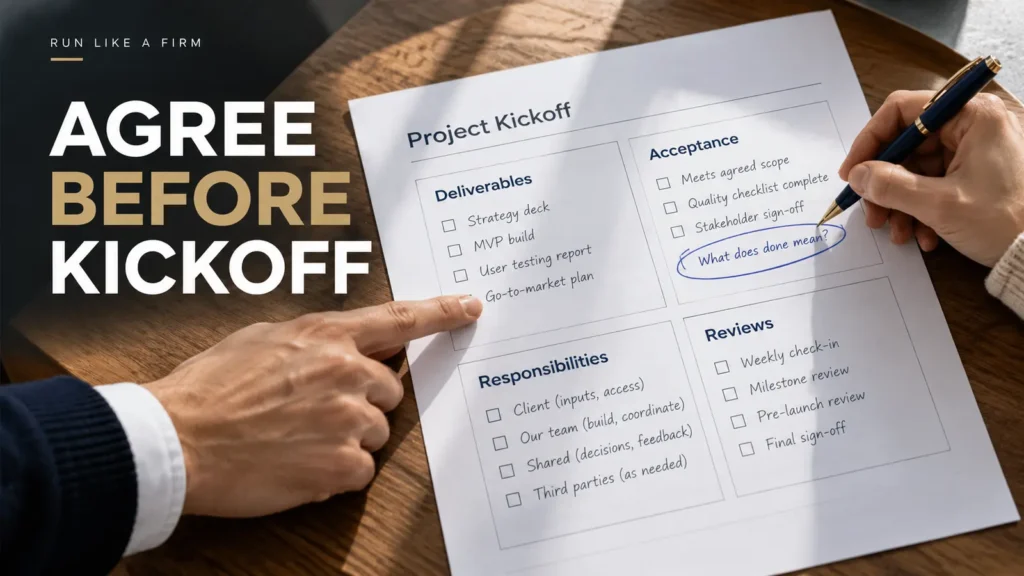
Manage client expectations before kickoff by agreeing the project's purpose, deliverables, acceptance criteria, responsibilities, review arrangements, and change process. Make the agreements specific enough to guide what happens during the work.
A signed proposal can still leave different interpretations of “complete website,” “quick turnaround,” or “better conversions.” Resolve the important differences before production turns them into rework or a dispute.
Distinguish success from delivery acceptance
The client may hope the project increases revenue. Your deliverable might be a new inquiry process. The process can meet its agreed specification even when revenue is affected by factors outside the project.
Define both:
- Business objective: the improvement the client wants the work to support.
- Delivery acceptance: the observable conditions the agreed work must meet.
For example, a business objective may be “respond more consistently to suitable inquiries.” Acceptance criteria may include correct routing of agreed inquiry types, visible ownership, and successful testing of specified scenarios.
Do not use acceptance criteria to dismiss the business objective. The work still needs a sensible connection to it. Conversely, do not promise a business result you cannot substantiate or control.
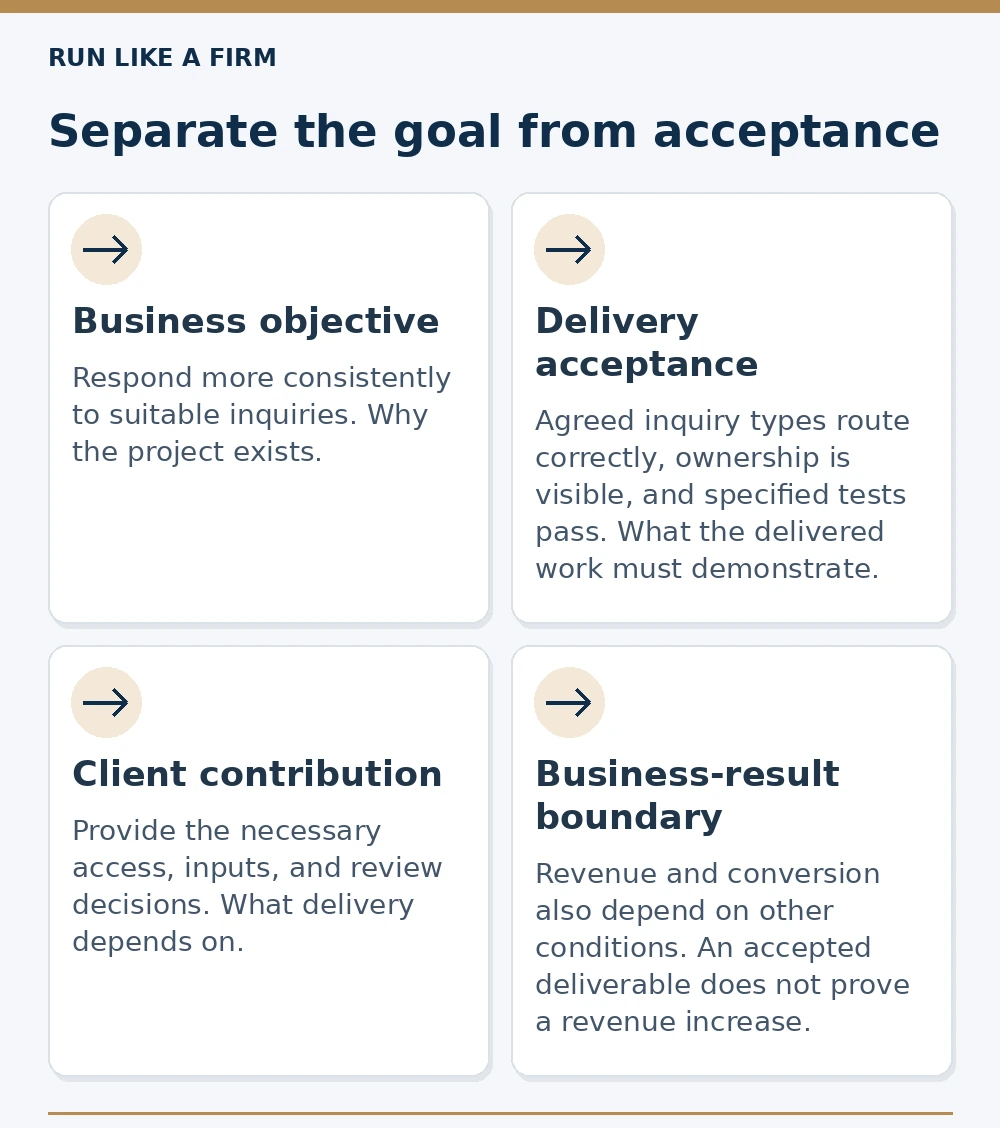
Read the decision map as text
- Business objective: Respond more consistently to suitable inquiries. Why the project exists.
- Delivery acceptance: Agreed inquiry types route correctly, ownership is visible, and specified tests pass. What the delivered work must demonstrate.
- Client contribution: Provide the necessary access, inputs, and review decisions. What delivery depends on.
- Business-result boundary: Revenue and conversion also depend on other conditions. An accepted deliverable does not prove a revenue increase.
Fictional example: an inquiry-routing project. Acceptance criteria should connect to the goal without guaranteeing an unsupported result.
Translate vague expectations into useful agreements
These examples are fictional and should be adapted to the engagement.
| Vague expectation | Agreement that can guide the work |
|---|---|
| “Make it professional” | Identify approved brand references, required content, and who reviews the final version |
| “We need it quickly” | Agree the launch reason, production sequence, input dates, and review windows |
| “Keep us updated” | Agree the update channel, cadence, contents, and exception triggers |
| “We'll send feedback” | Name the reviewer who consolidates comments and the deadline for each review |
| “Include everything we need” | List the agreed first-release requirements and separately note exclusions or future work |
| “It should improve conversions” | Clarify the intended action, baseline evidence, project contribution, and measurement limits |
An operational agreement does not need to be complex. It needs to resolve a real ambiguity.
Check the expectations of the people who matter
Your day-to-day contact may understand the scope while another stakeholder expects additional work. Invite the people who own essential inputs, approvals, or the final outcome into the relevant discussion.
Do not involve everyone in every decision. A reviewer can provide specialist feedback without becoming the final approver. Establish who resolves conflicting requests.
Ask each relevant person to explain what a useful outcome would look like. Differences are not automatically a problem; unresolved differences are.
For instance, a marketing manager may prioritize a simple inquiry form while operations needs enough information to route requests. Agree which information is essential for the first release and how the remaining needs will be handled.
Use a defined client approval process to make the review owner and requested decision clear.
Set a mutual operating baseline
Before substantial production begins, confirm the arrangements that materially affect delivery:
- The current scope and version of the approved brief.
- The owner and timing of client inputs.
- The review and approval arrangements.
- Communication channels and response expectations.
- What counts as a correction, revision, or additional request.
- How a dependency failure or material change will be discussed.
Use these questions to clarify the arrangement, then reflect the relevant decisions in your engagement documents.
Asana's project-kickoff guide treats kickoff as an opportunity to align the team on goals and the plan. PMI's discussion of client expectation alignment also emphasizes shared understanding. Neither means a meeting alone guarantees alignment.
Confirm understanding with a concrete example
Instead of asking only “Does everyone understand?”, test a likely situation.
If feedback arrives after the agreed review window, what happens to the next production stage?
If a stakeholder requests a new page during the second revision round, how will we assess it?
Who decides when two reviewers request conflicting directions?
These questions expose whether the arrangement can guide actual behavior.
Do not insert a punitive consequence the client never agreed to. Discuss feasible responses and record the chosen arrangement. If delay affects your availability, be honest about what can and cannot remain reserved.
A worked kickoff clarification
Hypothetical event-site kickoff, October 29, 2026. Three stakeholders describe different launch expectations: the marketing manager wants a short event inquiry form, operations needs enough information to route requests, and the director expects the full service website before the event.
The designer compares those expectations with approved brief v2: an event landing page and one inquiry route first, with the remaining service pages in a later release. Marketing and operations agree the essential routing fields and test cases. The director, who authorizes the release boundary, confirms the event-page first release; the later service pages retain their separate schedule. Specialist reviewers supply input, while the named approver resolves the release decision.
If the director instead requires the full site for the event, the designer must assess and agree a revised scope, schedule and fee. A kickoff recap cannot silently expand brief v2 or settle the disagreement through silence.
Send a kickoff recap that can reveal disagreement
The recap below records the same fictional decision. It links operating arrangements to the approved scope rather than creating another scope document.
Subject: Event-site kickoff recap — brief v2, October 29, 2026
Scope baseline: Approved brief v2, dated October 28, covers the event landing page and one inquiry route. The service pages remain in their separately scheduled release. Brief v2 governs the work boundary; any discrepancy in this recap needs correction before production.
Acceptance: The page uses approved event facts and brand references. Agreed test submissions reach the nominated operations inbox, show the required routing information and receive a confirmed receipt check under the recorded test conditions.
Inputs / owners: The marketing manager supplies approved copy/images by November 2, 2026, 3:00 p.m. Operations confirms the recipient, required fields and test access by the same time. The designer checks completeness and access before confirming production readiness.
Reviewer / approver: Alex, the marketing manager, consolidates comments from marketing and operations. Operations verifies routing. The director authorizes final release against brief v2 and resolves any remaining conflict; specialist checks still need to be completed.
Milestones / review windows: Draft November 4 at 3:00 p.m.; consolidated feedback November 5 at 3:00 p.m.; revisions and final review November 6, with the release decision requested by 3:00 p.m. Planned launch November 9 follows approval. All times are America/New_York. These dates depend on timely complete inputs and agreed checks; the requested decision time is not proof of approval.
Channels: The shared project thread holds routine questions and weekly updates; the current document holds consolidated comments. A call resolves conflicting instructions, followed by a written decision in the thread. For this example, messages are reviewed within one business day during the provider’s stated working hours; this is not continuous availability.
Changes / missed windows: Compare requests with brief v2 before assessing a change. If input or review timing slips, the designer identifies the affected milestone and proposes revised dates for confirmation. No automatic fee or approval follows from silence.
Next action: Alex checks this recap with operations and the director and flags factual disagreements by October 30, 2026, 3:00 p.m. The designer records the corrected understanding and obtains the required decisions before dependent work starts.
Invite corrections to substantive points rather than asking for a general “all good.” If the client expects the remaining pages at the same launch, you have found a disagreement worth resolving now.
The recap records understanding; it does not replace the approvals or engagement documents your arrangement requires.
When the baseline changes, assess the scope change before accepting new work.
Review scope, price, and outcome alignment before the commercial agreement to make expectations explicit.
Revisit expectations when conditions change
Alignment is a baseline, not a one-time guarantee. A new stakeholder, changed priority, missing input, or revised business objective may make the original plan unsuitable.
When that happens, identify the change and its consequences. Decide whether to adjust scope, timing, fee, or sequencing before proceeding.
A routine status update should point out significant deviations. It should not quietly describe a different project as though it were the same one everyone approved.
Repair misalignment without making the client the villain
If the disagreement arises from your ambiguous wording, acknowledge it. Clarify the options and propose a fair resolution. If the client requests work beyond a clear agreement, explain that boundary and assess the request.
You may discover that the original scope was genuinely incomplete. Treat that as a planning problem to solve, not proof the client behaved badly.
Before kickoff, ask the client to describe the expected result, their responsibilities, and the next approval in their own words. Compare that description with your plan. Resolve the important differences before production makes them expensive to change.