

Before writing a proposal, check whether the proposed work supports the client's intended outcome at a price and under conditions both sides can accept. The deliverables, fee, expected change, dependencies, and limits should describe the same engagement.
This is a final alignment check, not a promise that your work can guarantee a commercial result. You can commit to defined work and acceptance criteria while explaining that outcomes also depend on the client's actions and other conditions.
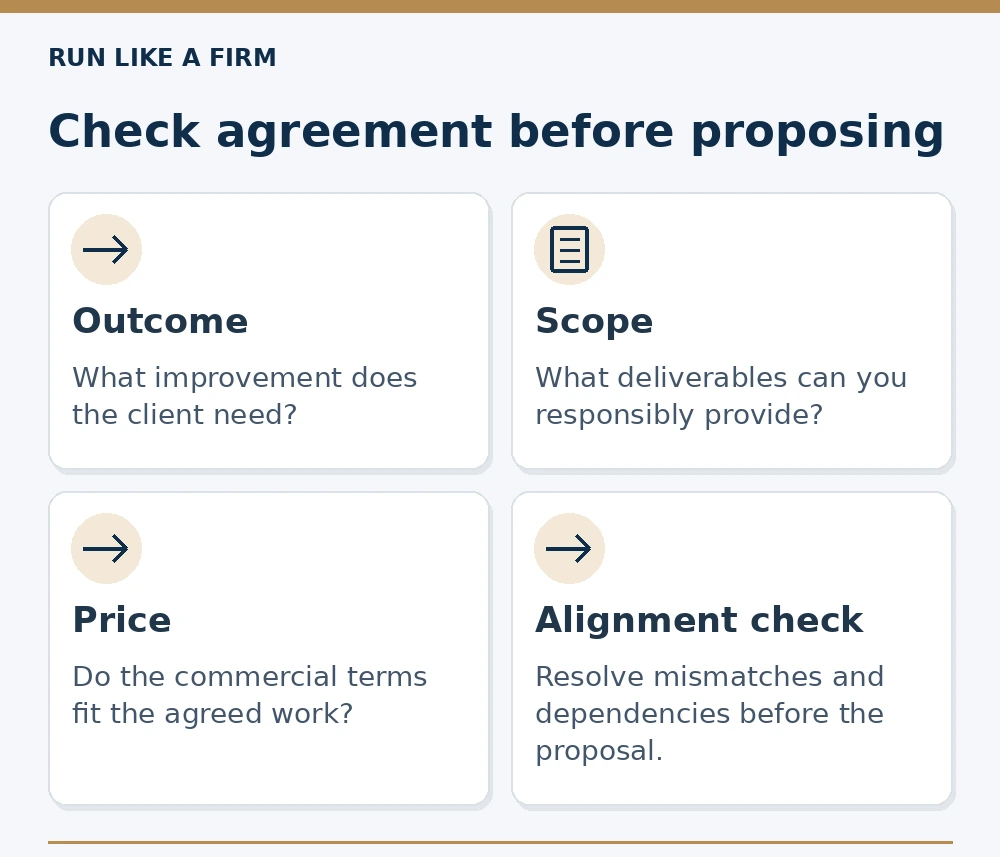
Read the decision map as text
- Outcome: What improvement does the client need?
- Scope: What deliverables can you responsibly provide?
- Price: Do the commercial terms fit the agreed work?
- Alignment check: Resolve mismatches and dependencies before the proposal.
Distinguish the deliverable from the outcome
A deliverable is what you produce. An outcome is the change the client wants from using it. Business impact is a further consequence that may depend on factors outside the engagement.
| Level | Fictional service example | Appropriate commitment |
|---|---|---|
| Deliverable | Five rewritten service pages | Define the pages, review rounds, and handoff |
| Intended outcome | Prospects can understand the offer more easily | Explain the design rationale and evaluation method |
| Business impact | More qualified inquiries | Treat it as an objective requiring measurement, not a guaranteed result |
If the client wants more inquiries but the project addresses only page wording, ask whether traffic volume, offer fit, contact usability, or sales follow-up also matter. You do not need to sell all of those services. You do need to explain the boundary of the contribution you are proposing.
Start with the confirmed client problem statement so the outcome has a shared basis.
Use an alignment record before designing the document
Complete one record before drafting. Link to the evidence and current scope rather than creating another agreement. The worked example below fills the same fields.
Problem / evidence:
Desired outcome:
Deliverables / acceptance:
Dependencies:
Budget / proposed fee (currency and tax basis):
Conflict:
Options:
Decision:
Owner / decision date:
Open conditions / required-by / next review:
Find the mismatch before asking for approval
Several different problems can look like price resistance:
| Mismatch | Example | Response |
|---|---|---|
| Outcome exceeds the proposed contribution | Buyer expects sales growth from a visual refresh alone | Clarify dependencies and narrow the claim |
| Scope exceeds the available budget | Buyer needs ten pages but can fund three | Define a useful first phase or decline |
| Price is being assessed against different work | Buyer compares writing with editing existing copy | Explain the scope difference |
| Evidence is insufficient | The proposed solution relies on an untested cause | Investigate before committing to implementation |
| Delivery conditions are unworkable | Required inputs arrive after the promised completion date | Adjust timing, responsibilities, or scope |
Rewriting the value proposition will not resolve an impossible dependency. A discount will not make an unsupported solution suitable. Identify which constraint needs changing.
Use the worksheet to scope the project when the deliverables are still unclear.
Worked example: the offer is stronger after it becomes narrower
Hypothetical teaching example; the fees are assumptions, not market benchmarks. A consultancy asks a copywriter to “make the website convert.” Its marketing lead identifies inconsistent offer descriptions during discovery. Traffic quality and form performance remain untested, so rewriting cannot responsibly promise more inquiries.
Weak offer: We will rewrite your website to generate more leads and increase revenue.
The first proposed boundary is five service pages for USD 4,000. The marketing lead confirms a USD 2,500 budget ceiling. Keeping all five pages at that price would leave the delivery plan uneconomic under the copywriter’s estimate. The decision is about changing the work, rather than inventing revenue to justify the fee.
- Problem / evidence
- The discovery notes and current five-page copy show conflicting audience and service descriptions; the marketing lead confirms the factual inconsistencies on October 28, 2026. Their effect on inquiries is unknown.
- Desired outcome
- Give prospects a clearer explanation of two priority services. An increase in qualified inquiries remains a later business objective.
- Deliverables / acceptance
- Rewrite two named priority service pages, using one stakeholder interview and two consolidated revision rounds. Each page must include the agreed audience, service, boundaries and next step; the authorized content approver checks factual accuracy. Deliver editable copy after agreed corrections. Implementing it on the website is outside scope.
- Dependencies
- The marketing lead supplies approved service facts and one consolidated response per round. The web owner implements the approved copy. Neither dependency is replaced by the writing fee.
- Budget / proposed fee
- Budget ceiling: USD 2,500. Revised two-page fee: USD 2,400, subject to written agreement. Amounts are before any applicable tax; tax treatment and payment dates must be confirmed in the proposal.
- Conflict
- Five-page scope exceeds the available budget; a promise of acquisition growth also exceeds the available evidence.
- Options
- Fund the five-page version at USD 4,000; start with two independently useful priority pages at USD 2,400; or defer the engagement. A complete acquisition diagnosis would require a separately evaluated scope.
- Decision
- The marketing lead selects the two-page option for the proposal, pending budget authorization. Three remaining pages, traffic analysis, form testing and acquisition reporting are deferred or excluded. The smaller scope improves those two pages; it does not resolve every possible cause of weak inquiries.
- Owner / decision date
- The copywriter records this version on October 29, 2026. The marketing lead routes it to the budget holder; the internal sponsor need not hold every approval authority.
- Open conditions
- The marketing lead confirms the two page URLs, content approver and implementation owner by November 2, 2026, 3:00 p.m., America/New_York. The copywriter reviews the conditions then and prepares the final schedule and payment milestones only against that confirmed version. No production start is authorized by this record.
The aligned offer now promises two reviewable outputs at a corresponding fee. Use the linked scoping guide for the estimate and the proposal guide for the buyer-facing document; this record resolves the mismatch between them.
Connect the price to the engagement without inventing ROI
Explain what the fee covers and the decisions behind the approach. You do not have to publish every internal cost or expose unrelated commercial information. You do have to avoid hiding material assumptions.
For a fixed fee, confirm the work boundary. For hourly work, clarify the rate, estimate where available, review points, and authorization for additional time. For a retainer, define whether it buys access, capacity, recurring outputs, or some other arrangement.
Avoid a fabricated return calculation such as “One new client will pay for the project” unless you have an appropriate basis and clearly state uncertainty. Even a real average client value does not establish that this engagement will generate a new client.
If the buyer cannot assess the proposed investment yet, ask what information they need for a decision. That might be a scope comparison, a smaller test, or involvement from a budget owner.
Once the decisions are aligned, use the freelance proposal guide to present the agreement.
Keep acceptance criteria separate from success metrics
Acceptance criteria establish whether the agreed work is complete. Success metrics evaluate the effect of using the work.
For the revised two-page project, acceptance might include both approved pages delivered, factual corrections completed, agreed offer information present, and handoff format correct. A success metric might track the quality of subsequent inquiries over a defined period.
Do not make an unmeasured success objective an accidental acceptance condition. Equally, do not call delivery a commercial success simply because the files were handed over.
State who collects any later data, the comparison period, and the limitations. If measurement is outside scope, say so and avoid promising a report you have not priced.
Confirm the people who can make the decision
The person discussing the offer may not authorize budget, accept the deliverables, or control implementation. Identify who needs to confirm which part.
Ask practical questions: who approves the engagement, who verifies the content, and who implements the work? One person can hold several roles. A large committee is not automatically a problem if responsibilities are clear.
Do not bypass your contact to create pressure. Ask how the decision should be handled and supply material they can share internally.
Handle “Can you send the proposal anyway?”
You can prepare a provisional proposal when appropriate, provided the assumptions and open decisions are visible. Do not present it as implementation-ready if a critical dependency remains unresolved.
I can send a proposal based on the two-page scope we discussed. It will identify the implementation owner and source-information approval as conditions still to confirm. If those conditions change the work or timing, we will revise the plan before committing.
For a fundamental uncertainty about the problem or feasibility, a bounded discovery proposal may be more responsible than an implementation proposal.
Run the final consistency check
Read the proposed scope, price, and outcome side by side. Does the work support the stated change? Can it be delivered under the named conditions? Does the fee correspond to that version? Can the client distinguish what you promise from what you hope will happen?
If an answer is unclear, fix the underlying mismatch before formatting the proposal. The useful next step is a shared engagement that can be evaluated, not a more persuasive document built around incompatible assumptions.