

Before pricing a freelance project, define what you will deliver, what completion means, what the client must supply, and which uncertainties could change the work. Then choose an estimate or engagement structure that fits what you know. A project label alone is not enough to support a fixed fee.
You can discuss a real starting price or rate early. The mistake is presenting that indication as a reliable price for work whose boundaries are still unknown.
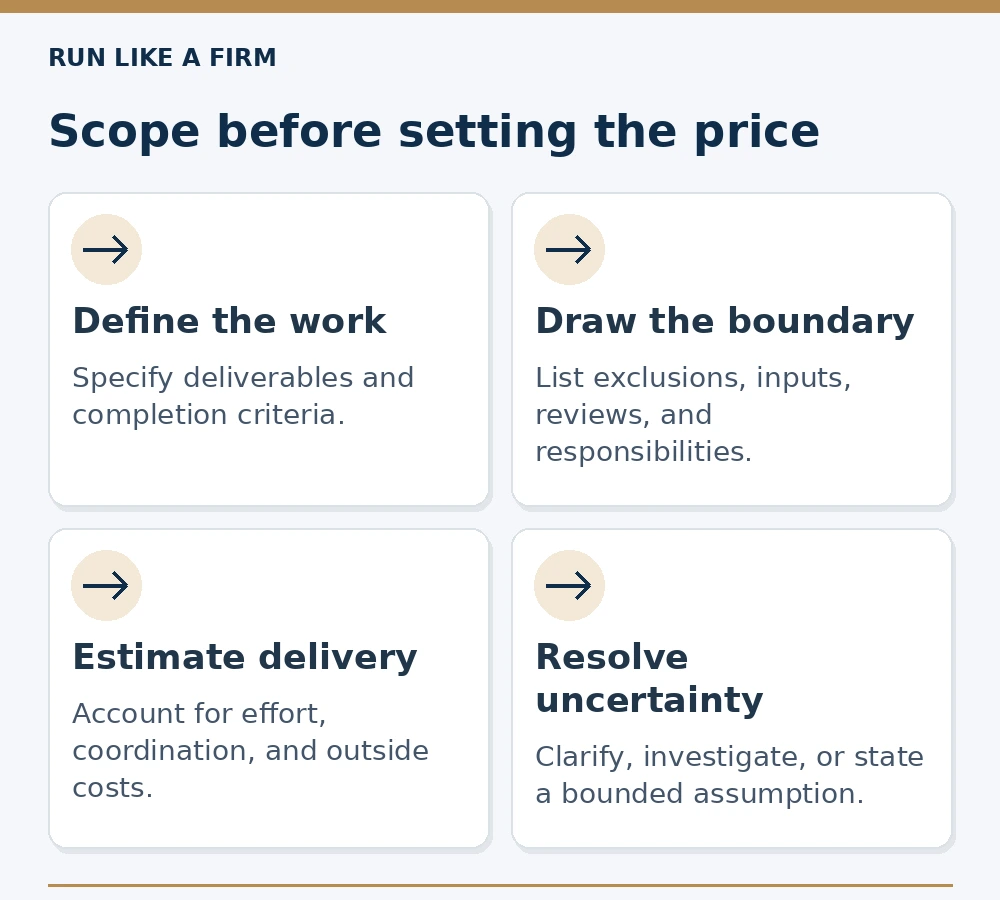
Read the decision map as text
- Define the work: Specify deliverables and completion criteria.
- Draw the boundary: List exclusions, inputs, reviews, and responsibilities.
- Estimate delivery: Account for effort, coordination, and outside costs.
- Resolve uncertainty: Clarify, investigate, or state a bounded assumption.
Identify which kind of price the client needs
Sometimes the buyer needs to know whether your services are broadly affordable. Sometimes they need a detailed estimate for approval. Sometimes they are asking you to commit to a price and delivery date.
Those are different requests:
| Pricing stage | What you can provide | What to make clear |
|---|---|---|
| Early affordability check | Actual rate, starting fee, or grounded range | What the indication covers and excludes |
| Defined work with some uncertainty | Estimate with assumptions | What could change the estimate |
| Bounded work you can responsibly commit to | Project quote under your agreed terms | Scope, conditions, and change route |
| Material uncertainty needing investigation | Bounded discovery engagement or another suitable structure | Discovery outputs and how later work will be priced |
Do not use “estimate” and “quote” interchangeably in a document. Their practical and legal effects can depend on the wording and jurisdiction; state the commitment you intend and use appropriate terms.
If the same scope recurs, use it to package freelance services while retaining clear boundaries.
Write deliverables that someone can check
“Build a website” conceals too many choices. “Rewrite five approved service pages using client-supplied product details, with two consolidated revision rounds” describes work you can begin estimating.
For each deliverable, specify:
- The output and its quantity or boundary.
- The work needed to produce it.
- The included review and revision arrangement.
- How completion will be checked.
- What related work is excluded or deferred.
Use detail where it changes effort or acceptance. A tiny editing job does not need a long specification. An integration involving unknown data formats does need more than “connect the systems.”
Make client inputs part of the scope
Your price may assume the client provides final copy, usable data, brand assets, access, or consolidated feedback. Name those inputs and check whether they exist.
| Dependency | Question before estimating | Possible consequence |
|---|---|---|
| Source content | Is it complete and approved? | Writing may be additional work |
| Data migration | Can you inspect a representative export? | Cleaning or mapping may need investigation |
| Reviews | Who consolidates comments? | More coordination may be required |
| Access | Are permissions and accounts available? | Setup or waiting may affect the schedule |
| Third-party services | Are compatibility and charges known? | Testing and external costs may change |
Do not silently make the client responsible for an input they cannot realistically provide. Discuss an alternative and include the associated work if you will take it on.
Check scope, price, and outcome together after the work is defined.
Work through a fictional five-page copy project
Suppose a client asks for “five pages of website copy.” You clarify that each page covers one service, existing product information is available, two stakeholder interviews are needed, and the client wants two consolidated review rounds.
Your estimate must include more than typing the pages. A fictional effort breakdown might be:
| Work | Estimated hours |
|---|---|
| Review materials and prepare interviews | 3 |
| Conduct interviews and consolidate notes | 3 |
| Draft the five pages | 10 |
| Complete two bounded revision rounds | 4 |
| Final checks and handoff | 2 |
| Project coordination | 2 |
| Total planned effort | 24 |
These figures are illustrative, not recommended hours or market rates. Replace them with your experience and the actual work.
If you use an internal planning rate of $80 per hour, the effort component is 24 × $80 = $1,920. That is not automatically the final price. You still need to account for direct costs, overhead treatment, uncertainty, capacity, taxes where applicable, and your pricing method. Avoid counting the same cost twice.
For a complete planning example, define the $80 internal rate as $65 for labor plus $15 for allocated overhead per hour. Add a separate $120 transcription cost only if it is not already included in that rate. The assigned cost estimate is (24 × $65) + (24 × $15) + $120 = $2,040. These are teaching assumptions, not market rates or a prescribed price.
If your $80 rate instead includes all overhead and transcription, the estimate remains $1,920: adding the $120 again would double-count it. If the rate includes a profit allowance, separate that allowance before calling the result a cost estimate.
Estimate record — five-page copy project (illustrative)
Tasks / hours: use the 24-hour breakdown above
Cost basis: $65 labor + $15 allocated overhead per hour
Direct outside cost: $120 transcription, counted once
Defined assigned costs: $2,040; one currency, USD
Dependencies: two interviews, approved source details, one feedback coordinator
Assumptions: five service pages; two consolidated revision rounds
Uncertainty: research beyond the supplied product information is not estimated
Status: internal estimate; not a committed client quote
Next action: confirm research and inputs before setting the fee
Separate three causes of an overrun: a sixth page is a scope change to evaluate and agree before production; needing extra drafting time for the same five pages may be your estimating error; late client inputs may affect the schedule without automatically creating a charge. Record the actual effect and use the agreed change process where relevant.
If the interviews reveal the need for substantial product research, the original effort model changes. That is why the scope and assumptions must be explicit before a fixed commitment.
Keep an uncertainty list alongside the estimate
A contingency allowance does not make every unknown safe. Identify what is uncertain, its possible effect, and the proportionate response.
For example:
- Small variation in editing effort: allow for it using relevant past work.
- Unknown data quality: inspect a sample before pricing migration.
- New third-party integration: run a bounded technical check.
- Unconfirmed page list: ask the client to confirm the first version.
- Open-ended strategic questions: define a discovery step rather than pretending implementation is bounded.
Use ranges only when you have a basis for both ends. A wide range made up to reassure the buyer is still a guess. Explain the assumptions and when the range can be narrowed.
Milan Parmar’s questions to ask before hiring a freelance developer discuss price inclusions, scope changes, inputs and decision ownership from the buyer’s perspective. This is hiring guidance, not a worked scoping case study. Source destination checked October 26, 2026.
For controls during delivery, use the separate guide to scope creep prevention.
When the buyer wants a price before supplying details
Answer the stage they are actually at:
I can share my usual starting fee for this service, but not a fixed price for the full project yet. The page list and research requirements will change the work. If you send those details, I can prepare a scoped estimate. If the brief still needs developing, we can first define a separate discovery step.
If investigation is needed, identify what you must check and give a feasible response date. The appropriate estimating period depends on that work; there is no universal waiting period in this framework.
For an urgent request, explain which uncertainties remain. You may offer a smaller bounded first phase. Do not remove necessary research while promising the same level of reliability.
Confirm the baseline before preparing the final offer
Send a short scope summary with deliverables, exclusions, inputs, review arrangements, and acceptance checks. Ask the client to correct it before you commit.
If their correction adds a deliverable, update the effort estimate. If it reveals that your interpretation was wrong, fix the interpretation. Both can change the price; neither automatically means the client is causing scope creep.
Keep the agreed version attached to the eventual engagement. Later requests can then be compared with a real baseline rather than someone's memory of the first call.
Scope is not a guarantee of profitability
Defined scope reduces ambiguity, but you can still underestimate effort, incur unexpected costs, or choose a price that does not cover your economics. Compare planned and actual work after delivery and update future estimates.
Do not blame the client for an overrun before separating additional requirements from your estimating errors and rework. The purpose of scoping is to support a responsible commitment, not to make every difference billable.
For your next quote, write the deliverables and uncertainty list first. If one unknown could materially change the commitment, resolve it or change the engagement structure before offering a fixed fee.