

When a client asks for a discount, clarify the constraint before changing the fee. Then decide whether to keep the price, reduce the scope, change suitable terms, offer a deliberate concession, or decline. A lower price is a commercial decision with consequences for your costs and capacity, not a required response to negotiation.
The request itself does not prove that the client is disrespectful or will be difficult. It may reflect a budget limit, a procurement routine, a comparison with different work, or uncertainty about the offer. Find out which issue you are answering.
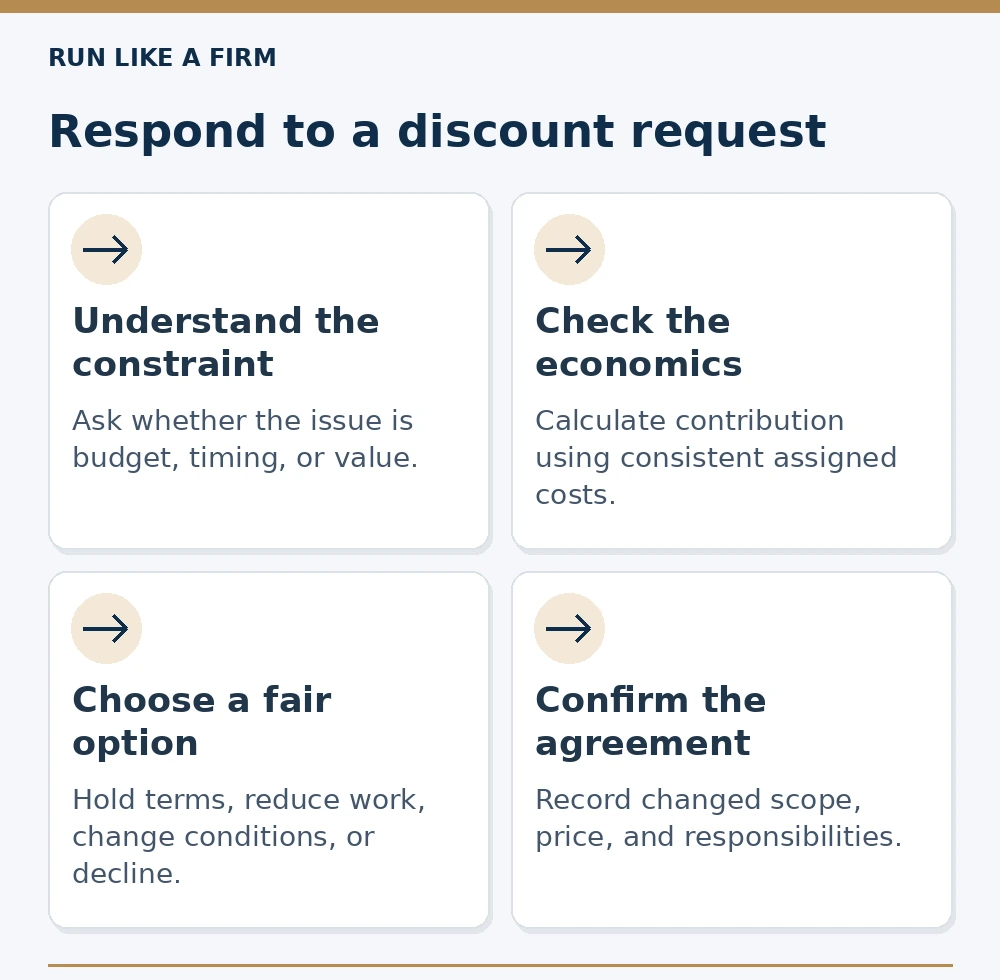
Read the decision map as text
- Understand the constraint: Ask whether the issue is budget, timing, or value.
- Check the economics: Calculate contribution using consistent assigned costs.
- Choose a fair option: Hold terms, reduce work, change conditions, or decline.
- Confirm the agreement: Record changed scope, price, and responsibilities.
Ask one useful question before defending the price
Try a neutral clarification:
Is the main constraint the total budget, the payment timing, or uncertainty about what the project includes? That will help me suggest an appropriate option.
Do not demand a justification for the client's finances. You need enough context to discuss a feasible arrangement. If they simply want to know whether you negotiate, you can answer that directly.
Choose a response that addresses the constraint you have confirmed. A request to negotiate is not evidence of how the client will behave during delivery.
If a lower fee requires different work, scope the project before pricing again before offering the option.
Separate affordability from value uncertainty
If the client understands the offer but cannot fund it, repeating your credentials will not increase their budget. Discuss a smaller useful engagement or accept that the project may not proceed.
If the client does not understand the offer, explain the work, review process, and relevant limits. Compare like with like when another quote is involved. Differences in deliverables, rights, implementation, support, or assumptions can matter.
| Constraint | Response worth considering | What it does not solve |
|---|---|---|
| Total budget is lower | Smaller scope or a separate first phase | It cannot preserve every original deliverable automatically |
| Cash-flow timing | A payment arrangement you can support | It does not reduce the total cost of the work |
| Price comparison is unclear | Compare scope, assumptions, and terms | It does not prove your competitor is inferior |
| Buyer is uncertain about the approach | Clarify evidence or define a bounded first step | It does not justify an unsupported guarantee |
| Routine negotiation | State your policy or assess a concession | It does not require you to lower the fee |
Do not offer more work at the same fee merely because you have decided not to discount. Extra deliverables also consume capacity.
Calculate what the concession costs you
Consider this fictional fixed-fee project. Its price is $4,000, and its estimated delivery cost is $2,800. Delivery cost here includes the assigned labor cost and direct expenses; it excludes overhead and tax.
| Scenario | Price | Delivery cost | Contribution before overhead and tax | Project contribution percentage |
|---|---|---|---|---|
| Original scope and fee | $4,000 | $2,800 | $1,200 | 30.0% |
| Same work, 10% fee reduction | $3,600 | $2,800 | $800 | 22.2% |
| Reduced work at a lower fee | $3,600 | $2,400 | $1,200 | 33.3% |
Project contribution percentage is contribution divided by the fee. The second row reduces the fee by $400 (10%), while project contribution falls by $400, from $1,200 to $800: a 33.3% relative decline. Its share of the fee falls from 30.0% to 22.2%, a decline of about 7.8 percentage points. These are different comparisons. With a zero fee, the percentage is not calculable; retain any contribution amount separately.
The third row is possible only if removing work actually reduces the cost by $400. Deleting a deliverable that shares most of its setup with other work may save much less than expected. Estimate the revised work before presenting that option.
These are teaching figures, not target margins. If you exclude your own labor from cost, the apparent margin can hide an unsustainable workload. Define cost consistently and check whether the concession still supports your business.
Review scope, price, and outcome alignment when the objection reflects a different expectation of value.
Offer a smaller version that remains useful
Remove work deliberately. Preserve the elements needed for the smaller engagement to function.
Copy-and-customize template: Replace the text in square brackets with your project details before using it.
I can offer a three-page first phase at [revised fee], covering the homepage and two priority services. The remaining pages and additional interviews would be deferred. This version keeps the same factual review and final quality checks. I can send the revised scope if that suits your budget.
Do not remove necessary testing or accuracy checks while promising the original standard. A cheaper project can have fewer deliverables; it should not quietly become unsafe or unusable.
If the requested budget cannot fund a useful version, say so. An unsuitable low-cost engagement can create more frustration than a clear decline.
When a deliberate discount may make sense
You may choose a concession for a defined commercial reason: a genuine reduction in delivery cost, a suitable longer commitment, a specific promotion, or an intentional allocation of spare capacity. Check the actual exchange rather than assuming that every attractive term creates savings.
Upfront payment may reduce collection exposure but does not eliminate project risk. A longer deadline may help scheduling but may not reduce labor. Permission to publish a case study is not guaranteed financial value. Future work that is only mentioned is not a committed volume purchase.
If you offer a concession, record its amount, reason, scope, duration, and conditions. Confirm what happens if the conditions change. Avoid a vague promise of a “special rate” that neither side can interpret at renewal.
Record the chosen option clearly in the freelance proposal.
Three replies you can adapt
These are fictional examples. Use your real numbers and terms.
Keep the quoted fee
Thanks for asking. I can deliver the scope described at the quoted fee, but I cannot reduce that fee for the same work. If the budget is lower, I can review which deliverables could be deferred and propose a smaller first phase.
Change payment timing
If the issue is payment timing, we can discuss a milestone schedule. That would change when payments are due, rather than the total project fee. I would need to confirm an arrangement I can support before revising the agreement.
Make a bounded concession
Copy-and-customize template: Replace the text in square brackets with your project details before using it.
I can offer [amount] off this engagement under [specific condition]. The revised fee is [amount], and the scope remains [defined scope]. This concession applies to this engagement only; future work will be estimated separately.
The message should be calm and factual. You do not need to apologize for a sustainable price or imply that the client should feel guilty for asking.
What if the request arrives after you have done the work?
Separate a new negotiation from a genuine concern about the delivered work or billing. Check the agreement, accepted scope, authorizations, and what has actually been supplied.
If you made an error, investigate and offer an appropriate correction. If the client is asking for a lower price for accepted work, respond using the agreed terms. Do not improvise legal threats or add unapproved fees. A material payment dispute may require professional advice appropriate to the agreement and location.
An estimating error is also different from extra work requested by the client. You cannot automatically turn your own inaccurate estimate into a retrospective change charge.
Avoid two unhelpful rules
“Always discount to win the relationship” ignores your economics. “Never discount because it proves weakness” ignores legitimate commercial choices.
The practical rule is to understand the request, evaluate the consequence, and document the decision. For your next discount conversation, calculate the revised contribution before writing a reply. Then offer an option you can deliver responsibly.