

A freelance proposal should help a direct client decide whether to buy the recommended work. Include the problem and rationale, scope, deliverables, schedule and dependencies, fee and payment arrangements, relevant proof, responsibilities, and next step.
The sections need to describe the same engagement. A fixed fee for three pages cannot sit beside a vague promise to rewrite the whole website.
This guide includes a fictional worked proposal and explains how to adapt it. It covers project proposals for direct clients, rather than an Upwork application or a complete legal contract.
Answer the buyer's questions in a useful order
The client needs to understand the recommendation before evaluating its price. That does not require hiding the fee until the end of a long document. A brief summary can include the scope, investment, and timing, followed by the supporting detail.
| Proposal section | Question it answers |
|---|---|
| Project summary | What problem are we addressing, and what do you recommend? |
| Scope and deliverables | What work is included? |
| Exclusions and assumptions | What is outside the engagement, and what must be true? |
| Milestones and schedule | How will work proceed, and what can change the dates? |
| Investment and payment | What will the client pay, and when? |
| Responsibilities and reviews | Who supplies inputs and makes decisions? |
| Next step | How does the client proceed or request clarification? |
Include relevant proof where it supports the decision: a comparable project, a work sample, or documented capability. Avoid filling the proposal with unrelated credentials.
Bonsai's freelance proposal example also includes scope, investment, timing, and acceptance. A template can help organize these elements; it cannot supply the missing facts about your engagement.
A compact worked proposal
The following proposal is fictional. Its fee and schedule illustrate the structure; they are not market rates, legal terms, or an actual client result.
Project summary
Your existing service pages describe activities but do not clearly explain which service fits each buyer. The proposed work will clarify the offer and rewrite three agreed pages so readers can understand the service options and inquiry route.
The project is intended to improve the clarity of those pages. It does not promise a particular increase in inquiries or sales.
Scope and deliverables
- Review the three existing pages and supplied service information.
- Hold one 45-minute content briefing with the nominated reviewer.
- Draft the Strategy, Implementation and Support service pages, each 400–600 words, using the approved brief and voice references.
- Complete two consolidated revision rounds against that brief.
- Deliver the approved copy in a shared document.
Acceptance: All three named pages contain the agreed audience, service description, boundaries and inquiry action, match the approved service facts and voice references, and arrive as editable text in the shared document. The client’s authorized content approver checks these conditions; inquiry or sales growth is not an acceptance requirement.
Assumptions and inputs: The client owns or can authorize the supplied material, provides approved service facts and voice references, and names a marketing reviewer to consolidate comments and a content approver to accept the copy. Both roles must have access to the current document before the review window begins.
Exclusions: website development and implementation, additional pages, original customer research, SEO performance guarantees, and ongoing content maintenance.
Milestones and dependencies
Illustrative baseline v1, agreed October 29, 2026. All times below are 3:00 p.m., America/New_York, unless a different time is agreed. These dates assume the complete inputs and first payment arrive on time; use your actual working calendar when adapting them.
| Milestone | Date in 2026 | Owner / dependency |
|---|---|---|
| Confirm brief and starting inputs | November 2 | Client: approved facts, page list, voice references, reviewer and approver; provider confirms complete brief and document access. |
| First draft | November 11 | Provider supplies all three pages against baseline v1. |
| Round 1 feedback / revision | Feedback November 13; revised copy November 17 | Marketing reviewer returns one consolidated set; provider resolves comments against the brief. |
| Round 2 feedback | November 19 | Marketing reviewer consolidates remaining in-scope changes on the revised copy. |
| Final review and editable handoff | November 23 | Provider supplies final revisions for the content approver’s acceptance check. Any unmet agreed criterion is recorded and corrected; the calendar date alone does not establish acceptance. |
If inputs, access or decisions arrive late, the provider identifies the effect and proposes revised dates for confirmation. A requested change to the baseline is assessed before production; it does not silently enter the same schedule.
Investment and payment
Illustrative fixed fee: USD 1,800. Invoice 1 is issued October 29, 2026 for USD 900, due November 2 before drafting starts. Invoice 2 is issued at the agreed final handoff, planned November 23, for USD 900, due November 30. If the agreed handoff moves, confirm the corresponding invoice and due dates rather than billing an unfinished milestone as complete.
The example amounts exclude any applicable taxes. Tax treatment, any transfer charges, the payment method and production-slot conditions must be established in the actual commercial documents; this example supplies no jurisdiction-specific tax or contractual terms.
Responsibilities and changes
The provider prepares and revises the copy against baseline v1. The client supplies accurate service information and consolidates stakeholder feedback.
One revision round means one consolidated set of comments on the current draft, followed by the provider’s revision against the same brief. For example, the marketing reviewer resolves three colleagues’ conflicting terminology suggestions and sends one approved list on November 13. Separate messages received later are not automatically a new paid round: first determine whether they are corrections, remaining included feedback, or changed requirements. Corrections needed to meet the agreed brief are not sold as extra work.
A correction needed to meet the agreed brief is handled within the original scope. A request for a new page, different audience, or revised service proposition will be assessed separately before additional work begins.
Next step
Please confirm whether this scope matches the project. If it does, we will finalize the engagement documents and schedule kickoff. If a requirement is missing, identify it before accepting the scope.
Customize before sending: client and approver identities; evidence and page list; length, voice and acceptance criteria; input owners and document permissions; working calendar, review windows and time zone; fee, currency, invoices, taxes and payment conditions. Replace every illustrative date and confirm the recipient has authority to proceed.
For hourly work, substitute the actual rate, a qualified effort estimate, recording method and an authorization checkpoint before exceeding the agreed limit. For a retainer, define the covered period, recurring outputs or reserved capacity, request priorities and treatment of unused capacity. Keep the same clarity about inputs, acceptance and excluded work. The service offer guide helps define those boundaries before the document is written.
Explain why the recommendation fits
The worked example connects the observed issue with the proposed work: unclear service descriptions lead to a page-clarity engagement. It also limits the claim to what that work can reasonably support.
Your proposal should do the same. If the client requests a redesign but the available evidence points to broken inquiry routing, explain why a routing fix comes first. Do not sell the larger project simply because you can deliver it.
Where uncertainty remains, make it visible. An assumption buried in small print can be the most consequential part of a project.
Use the case-study guide to present relevant evidence with its context and limits.
Include relevant proof without inventing a result
The worked proposal above explains the project, but a real buyer may also need evidence that you can perform it. Add proof suited to that question: an authorized sample, a relevant completed deliverable, a verified case study, or a short explanation of how you will check the work.
For a new freelancer without a comparable client case, a clearly labeled self-initiated sample is more honest than a fictional testimonial. Explain what the sample demonstrates and which parts of the proposed engagement it does not establish.
For the page-copy proposal, acceptance could include accurate service facts, the three agreed pages, the approved voice references, and the specified handoff format. The client reviews those conditions against the confirmed brief. This makes the promised work assessable without turning an aspiration for more inquiries into a sales guarantee.
Keep proof close to the recommendation it supports. A long portfolio covering unrelated services can make the decision harder, even when the work itself is good.
Make the scope reviewable
Specify the relevant units: pages, routes, features, sessions, environments, or deliverable formats. Define what a revision round means for this engagement. “Unlimited support” and “complete optimization” are difficult to evaluate without boundaries.
Include exclusions that a reasonable client might otherwise expect. Do not add a long list of improbable exclusions just to make the document look thorough.
Be equally clear about defects. A delivery that fails the agreed specification should not be relabeled a change request merely because correction takes time.
Before kickoff, align expectations on inputs, reviews, and the meaning of completion.
Keep the schedule honest
Separate production time from elapsed calendar time. Three days of writing may still span two weeks if reviews and dependencies sit between stages.
For a fixed launch date, state the input and approval dates needed to support it. If those dates are not feasible, change the scope or schedule before acceptance.
Never claim that a date is guaranteed while leaving essential client dependencies unresolved.
Before drafting the proposal, align scope, price, and outcome with the client.
Distinguish the proposal from the final agreement
A proposal may be one part of the engagement documents, or the parties may use an integrated document. The effect depends on its content and the applicable rules. This guide addresses clarity and project decisions, not whether a particular document is legally sufficient.
Use appropriate professional support for contractual terms when needed. Do not assume a software signature button makes every term suitable for your situation.
If the buyer later stalls, diagnose the stalled proposal before redesigning the document.
Run a pre-send check
Read the proposal from the client's perspective:
- Does it reflect the need they described?
- Can they identify the recommended work and its rationale?
- Do the scope, price, and schedule describe the same project?
- Are the essential inputs, reviewer, and acceptance criteria clear?
- Are estimates and illustrative results labeled honestly?
- Can they identify the next action without asking you to explain the document?
If the proposal is stalled afterward, investigate the buying decision before rewriting the entire document. Clear structure helps a client evaluate the work; it cannot create budget, urgency, or approval authority that does not exist.
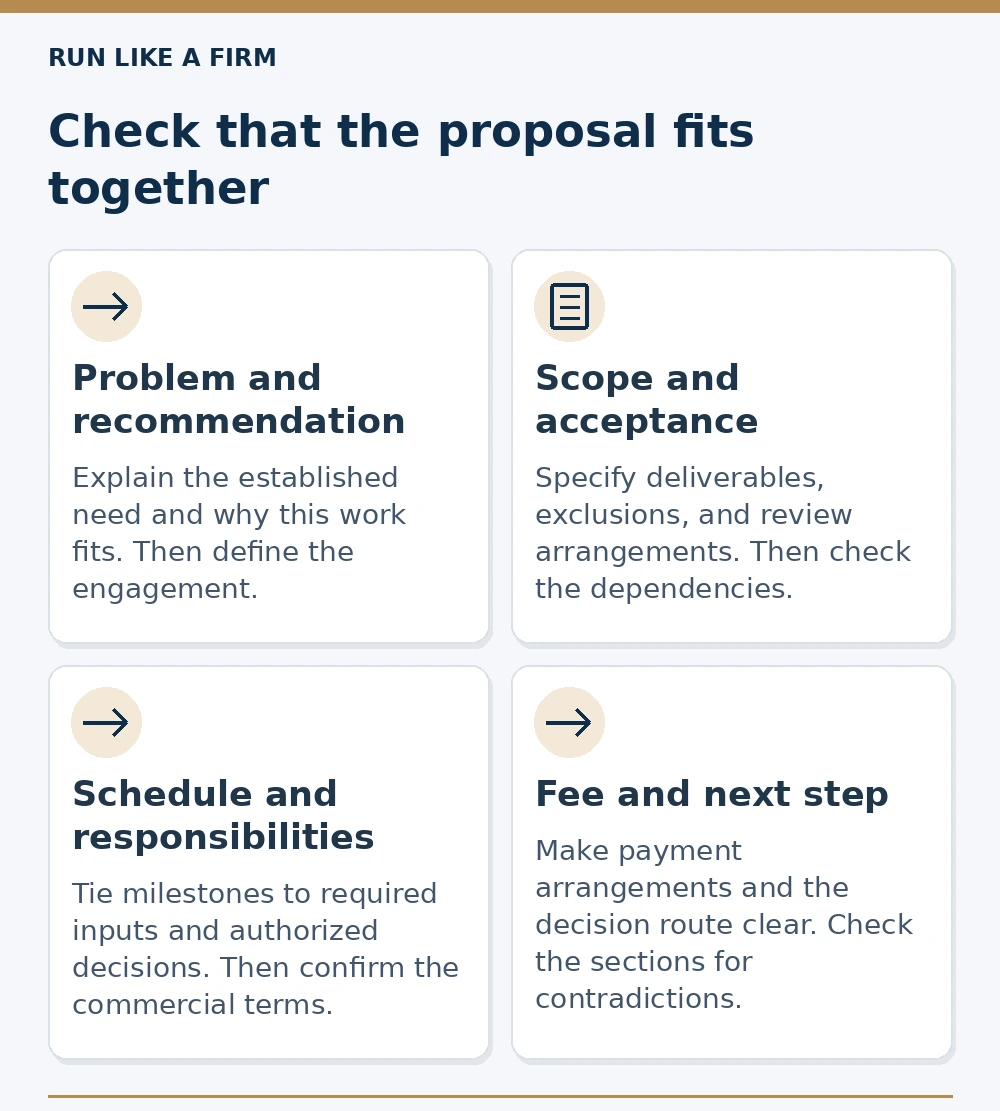
Read the decision map as text
- Problem and recommendation: Explain the established need and why this work fits. Then define the engagement.
- Scope and acceptance: Specify deliverables, exclusions, and review arrangements. Then check the dependencies.
- Schedule and responsibilities: Tie milestones to required inputs and authorized decisions. Then confirm the commercial terms.
- Fee and next step: Make payment arrangements and the decision route clear. Check the sections for contradictions.
Every section should describe the same engagement. Use genuine proof or labeled work samples; a proposal is not a complete legal agreement.