

Client retention depends on whether the relationship continues to meet a real need, deliver suitable value, and remain workable for both sides. For a service business, retention work begins before delivery: set realistic expectations, keep important decisions visible, address actual problems, and review whether another engagement is useful.
Regular messages and friendly service can support the relationship. They cannot guarantee renewal when the client's need, budget, priorities, or alternatives change.
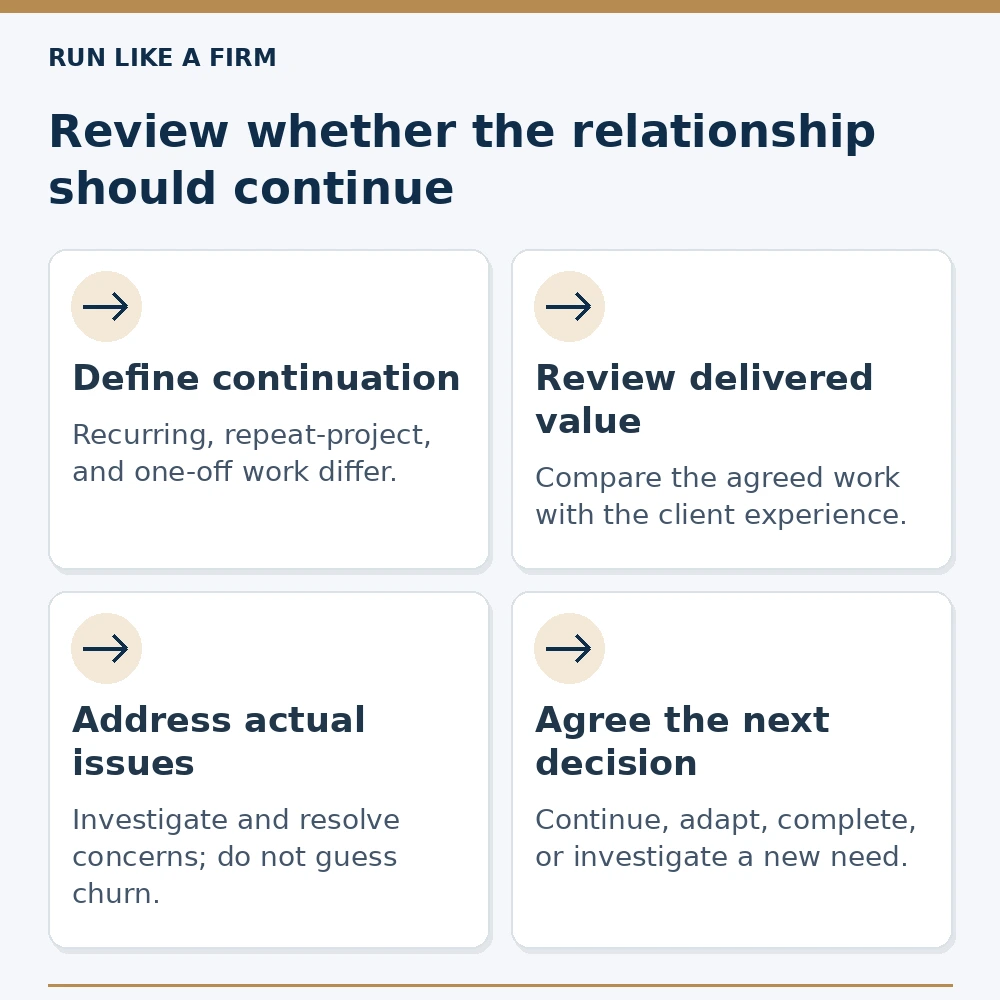
Read the decision map as text
- Define continuation: Recurring, repeat-project, and one-off work differ.
- Review delivered value: Compare the agreed work with the client experience.
- Address actual issues: Investigate and resolve concerns; do not guess churn.
- Agree the next decision: Continue, adapt, complete, or investigate a new need.
Decide what retention means for your service
A monthly bookkeeping engagement, a six-month implementation, and a one-off brand project should not be measured as though they have the same renewal pattern.
| Service model | Relevant continuation question | Misleading interpretation |
|---|---|---|
| Recurring service | Did clients eligible to continue remain under a defined rule? | Counting new clients as retained clients |
| Repeat project service | Did an earlier client purchase another appropriate engagement in the chosen window? | Calling every gap between projects churn |
| One-off service | Was the project completed well, with a suitable handoff and future contact permission? | Treating planned completion as retention failure |
Define the unit, observation window, eligibility, and continuation event before reporting a rate. Otherwise, a change in your client mix can look like a change in relationship quality.
If the review reveals an issue, address client concerns before discussing renewal.
Start with the expectations that affect continuation
At the beginning, make the outcome, deliverables, responsibilities, review process, and limits understandable. Ask what the client will need after delivery.
For a website implementation, will the client maintain it internally, need occasional support, or require an ongoing service? Do not assume the answer is a retainer. A sound handoff may be the right outcome.
Avoid selling certainty you cannot provide. If the client expects guaranteed revenue and your engagement delivers an operational improvement, clarify that difference before it becomes a renewal argument.
Retention should not depend on keeping the client confused or dependent. A relationship worth continuing gives the client a clear reason to choose the next engagement.
Review delivery facts and the client's experience together
An internal green status does not establish that the client can use the work. Ask about the experience while checking the actual commitments.
| Area | Question to ask | Evidence to examine |
|---|---|---|
| Delivery | Is the work meeting the agreed requirements? | Accepted deliverables and unresolved defects |
| Visibility | Can the client understand progress and next steps? | Updates, pending decisions, and feedback |
| Use | Has the work been implemented or adopted? | Handoff, training, and relevant usage information |
| Relevance | Does the original objective still matter? | Current priorities and sponsor input |
| Commercial fit | Is another engagement feasible and appropriate? | Need, budget, capacity, and terms |
Use answers to identify actions. Do not combine them into a universal health score and treat that score as a prediction of renewal.
Wrike's client-management guide emphasizes relationship clarity and communication. In practice, those conversations must be paired with delivery evidence and a check that the service still fits.
A confirmed new need can be assessed through the guide to client expansion opportunities.
Repair the actual problem before pitching more work
If the deliverable fails the agreement, investigate and correct it. If the client cannot use it, establish whether training, access, implementation, or suitability is the obstacle. If priorities changed, review the plan.
A discount on renewal does not repair a defective delivery. Another meeting does not fix missing access. An upsell may worsen the relationship if it arrives before a genuine unresolved issue has been addressed.
You can acknowledge an experience problem without inventing a cause:
The handoff has not given your team what it needs to use the workflow confidently. Let's identify which tasks remain unclear and whether the agreed training covered them. I will then confirm the appropriate correction or separate next step.
Keep a record of the action, owner, and follow-up date. Check completion rather than assuming reassurance has resolved the concern.
Hold a continuation review before the decision is urgent
Choose timing based on the service and the client's buying process. There is no universal number of days before renewal that fits every engagement.
Discuss:
- What was delivered and accepted.
- What has been used and what effects can be supported.
- What remains unresolved.
- What the client now needs.
- Whether continuation, a different scope, a pause, or completion is appropriate.
For a recurring service, include a decision date and the terms that would apply. For a completed project, request permission for a relevant future check-in rather than assuming an ongoing sales sequence.
If the budget owner or sponsor changed, find out how the relationship will now be evaluated. Do not rely on an enthusiastic contact who can no longer authorize the engagement.
When the work is useful and the relationship is ready, you can ask clients for referrals without making continuation a condition.
A fictional continuation conversation
An agency finishes a three-month content engagement. The agreed pages are complete, but the client has implemented only half because a launch priority changed.
The agency should not describe the full engagement as a measured lead-generation success. It can report accepted outputs, ask about the implementation constraint, and discuss whether a smaller support arrangement fits.
The agreed page work is complete. Three pages are live, and the remaining three are awaiting implementation. That limits what we can assess about inquiry outcomes. Is implementation still a priority, and would a bounded handoff session help your team finish it? We can also close the engagement if your priorities have changed.
The best next decision may be completion, a small additional engagement, or no further work. None should be predetermined by your revenue target.
A completed monthly-service renewal review
Separate hypothetical review, November 20, 2026: a consultancy’s monthly inquiry-handoff maintenance ends November 30. The provider and authorized operations sponsor review the two agreed routes, completed checks, exception log and client use. Required corrections are closed and checked; no unresolved obligation is offered as a new paid service.
The client still needs monthly route checks but not additional configuration work. The sponsor confirms a December budget and the provider checks capacity. They select a narrower December arrangement covering the two route checks, exceptions record and one review, with the fee, response window and exclusions documented before acceptance. The sponsor owns the renewal decision by November 25; the provider confirms the agreed December scope and records the next review for December 18, 2026, 3:00 p.m., America/New_York.
If budget authorization does not arrive, the record remains Pending; a positive conversation is not a renewal. The alternative is an agreed pause or completion with a usable handoff. This decision example explains why continuing can be useful without predicting that every client should renew.
Calculate retention using a consistent starting group
For a recurring service, one workable definition is:
Client retention rate = starting clients still active at the end ÷ eligible starting clients × 100.
In a fictional quarter, 20 clients are active at the start and eligible to continue. Sixteen remain active at the end. Retention for that starting group is 16 ÷ 20 × 100 = 80%. Five clients acquired during the quarter do not change that numerator.
Complete that same teaching cohort: the window is July 1–September 30, 2026. The eligible starting group is the 20 recurring clients active July 1 whose arrangements can continue through the window. One-off engagements with planned completion are tracked separately; eligibility is set before examining the result.
- Still active: 15 remain continuously active through September 30.
- Returned: one starting client pauses during the quarter and resumes an active recurring arrangement by September 30. Under this end-of-window definition, that client is included in the 16 retained; continuous retention would be a different measure.
- Paused: two starting clients remain on agreed pause at September 30. They stay in the starting denominator but are not active in this numerator. Report their paused status rather than calling both permanent losses.
- Ended: two starting clients end their arrangements before the window closes. Record the supported reason or Unknown.
- New clients: five acquired after July 1 are excluded from both the starting denominator and retained-starting-client numerator.
The continuation event here is an active recurring service arrangement at September 30, not an email reply, invoice alone or purchase of unrelated one-off work. The starting-group reconciliation is 15 + 1 + 2 + 2 = 20; the numerator is 15 + 1 = 16. A business may choose a different pause rule, but must define and report it consistently before comparing periods.
That rate does not explain why four left. Review departures individually: completed need, budget change, poor fit, dissatisfaction, closure, or another reason. Keep unknown reasons unknown.
For repeat-project work, choose a definition such as “clients from a specified completed-project group purchasing another engagement within 12 months.” Report the group and window explicitly. Do not compare it directly with monthly subscription retention.
Revenue retention is another measure. A smaller number of clients spending more can conceal client loss, so do not substitute revenue growth for the starting-client count.
Build a small relationship record
Keep the current objective, contact and decision owner, service arrangement, unresolved issues, next review, and contact permissions together. Include factual notes that help someone continue the work.
Avoid personality labels based on weak signals. A late reply is not proof that a client is leaving. A request for detail may reflect internal reporting rather than distrust.
For a small practice, a maintained table may be enough. Software is useful when it helps owners keep these records and actions current, not simply because it adds more fields.
When continuing would be the wrong decision
You may need to close a relationship that no longer fits your expertise, capacity, economics, or working conditions. Discuss alternatives where appropriate and provide a suitable transition under the agreement.
Do not call every departure a failure. A successful one-off engagement can end, generate a referral, and create goodwill without turning into recurring revenue.
Start with one upcoming client decision. Review the delivered facts, current need, and unresolved issues, then agree the next step. Healthy, sustainable retention seeks continuation that is useful and workable for both sides; a rate alone cannot establish that.