

Ask clients for referrals after they have experienced useful work, explain who you can help, and give them an easy way to make an introduction. Make the request optional and keep the next step small. A referral request should not create pressure to endorse results the client has not seen.
The aim is a relevant introduction with everyone's consent, not a list of the client's contacts.
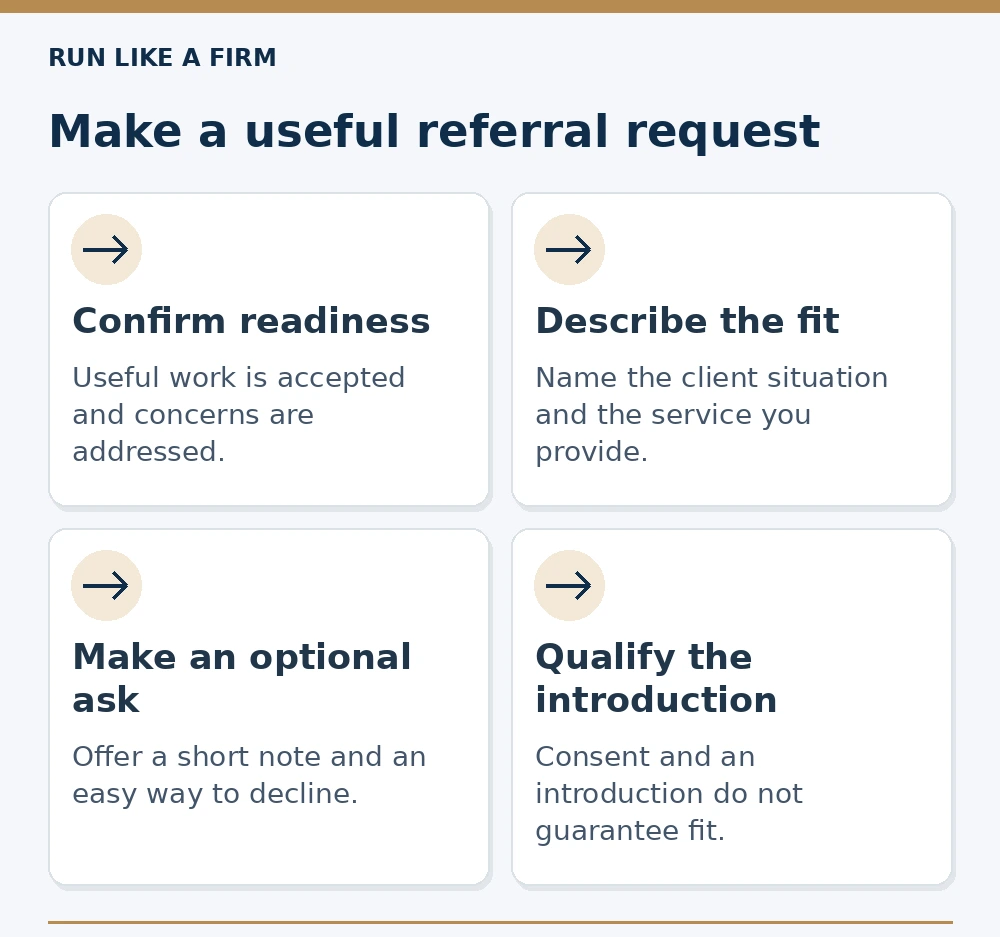
Read the decision map as text
- Confirm readiness: Useful work is accepted and concerns are addressed.
- Describe the fit: Name the client situation and the service you provide.
- Make an optional ask: Offer a short note and an easy way to decline.
- Qualify the introduction: Consent and an introduction do not guarantee fit.
Make a useful referral request. Confirm readiness: Useful work is accepted and concerns are addressed. Describe the fit: Name the client situation and the service you provide. Make an optional ask: Offer a short note and an easy way to decline. Qualify the introduction: Consent and an introduction do not guarantee fit.
Check whether the relationship is ready
A natural opening might follow accepted work, positive feedback, or a review in which the client confirms the work was useful. That is a better basis than sending a request simply because an invoice was paid.
Before asking, check for unresolved concerns, outstanding corrections, and uncertainty about the outcome. Finish or address those issues first. A client can appreciate your effort and still be unable to recommend the service confidently.
For recurring work, use a meaningful review point rather than waiting indefinitely for the engagement to end. For a one-off project, a good handoff may be the appropriate moment. Neither situation requires a referral request every time.
A relevant service business case study can support the introduction when you have permission to share it.
Describe the fit in language the client can recognize
“Do you know anyone who needs my services?” asks the client to do the targeting. Give a short description of the business, situation, and service that fit.
For example:
I help small service teams document their client onboarding process when handoffs and approvals are becoming difficult to manage.
That description is more useful than “I help businesses grow.” It gives the client a recognizable situation without requiring them to diagnose a friend's business.
Do not make the fit so narrow that the request becomes a research assignment. One or two defining conditions are usually enough to guide the introduction. If you serve several audiences, describe the one relevant to this client's network.
Use a short, optional request
Here is a copyable message. Replace every bracketed field with accurate details.
Copy-and-customize template: Replace the text in square brackets with your project details before using it.
Hi [Name],
Thank you for the feedback on [specific completed work]. I'm glad [the benefit the client actually confirmed] was useful.
I'm taking on [service] projects for [recognizable type of business or situation]. If someone comes to mind who is looking for help with that, would you be comfortable introducing us?
I can send a two-sentence summary you can forward. No problem if nobody comes to mind.
Thanks,
[Name]
Do not insert a benefit the client has not confirmed. “You doubled revenue after our project” would require evidence and appropriate attribution; it is not a harmless personalization detail.
The phrase “taking on projects” should also reflect real capacity. If you are booked, describe your next available window instead of inventing urgency.
Once introduced, respond to a new inquiry with the same care as any other prospective engagement.
Make the introduction easy to forward
A client who agrees to help should not have to write your pitch. Offer a short note they can adapt:
Copy-and-customize template: Replace the text in square brackets with your project details before using it.
[Your name] helps [type of client] with [specific service or problem]. They recently worked with us on [accurate description of your role]. If this is relevant to what you're working on, would you like an introduction?
This version lets the recipient opt in before contact details are shared. A mutual email introduction is also useful when both people agree. Do not request access to the client's address book or add a referred person to a mailing list without their agreement.
Include one useful link, such as a service page or a relevant case study you have permission to share. Do not attach a large portfolio or ask the client to forward confidential project details.
A hypothetical referral sequence
A freelance copywriter completes the agreed pages for a small consulting firm. In the handoff review, the client says that the new service descriptions are easier for the sales team to use.
The copywriter thanks the client and later asks whether anyone in their network is working through a similar service-description problem. The request includes a short explanation and makes declining easy.
The client thinks of a business owner but checks their interest first. After both agree, the client introduces them by email. The copywriter replies with a brief acknowledgment and asks the new contact about their situation.
The introduction is not a qualified opportunity yet. The new business might need a different service, have an unsuitable deadline, or have no available budget. The copywriter still uses a normal intake process before recommending work.
Use normal client qualification rather than assuming the referral is a fit.
Respond well to each answer
| Client response | Useful next step |
|---|---|
| “I have someone in mind” | Send the short forwardable note and let them check interest |
| “Send me some details” | Send the promised brief description and one relevant link |
| “Nobody comes to mind” | Thank them and leave it there |
| No response | Avoid repeated requests; use judgment about one brief follow-up |
| An introduction arrives | Thank the client and respond promptly to the new contact |
An existing client should not have to manage the new prospect's sales process. Take responsibility for the next conversation once the introduction is made.
If you promise to keep the referring client updated, keep the update brief and respect the new contact's privacy. “Thank you—we've connected” is often enough. Do not disclose the prospect's budget, difficulties, or buying decision without permission.
Keep referrals separate from testimonials
A referral introduces you to someone who may need your work. A testimonial is a public statement about a client's experience. A case study describes work, context, and supported outcomes. They have different uses and permissions.
If you want all three, make separate, clear requests at appropriate points. Do not bundle them into a long handoff email that turns a satisfied client into an unpaid marketing assistant.
You can ask for referrals without offering a reward. If you choose to introduce incentives, assess the applicable rules and disclosure requirements before launching the program; this article's templates assume no referral compensation.
Track quality, not just introductions
Record the source, introduction date, service fit, next step, and eventual outcome in your normal lead record. Track referred inquiries separately from qualified opportunities and signed engagements.
If ten introductions produce few suitable conversations, review your description of the client fit. Do not conclude that the clients “sent bad leads” before checking whether your request was clear.
A small sample is useful for inspecting individual cases, not for making confident claims about a channel's future conversion rate. Keep pending conversations separate from resolved wins and losses.
Frequently asked questions
Can I ask before the project is finished?
You can ask after a meaningful, accepted milestone if the client has enough experience to recommend your work. Do not ask while a significant delivery concern remains unresolved.
How often should I ask the same client?
Use relevant occasions and the client's response. There is no universal schedule. If they decline or have nobody in mind, avoid making the same request at every meeting.
What if a referral is a poor fit?
Thank both people, explain the mismatch respectfully, and suggest a suitable alternative only if you have one. A referral creates an introduction, not an obligation to accept work.