

Respond to a freelance client inquiry by answering what you can, clarifying the few facts needed for the next decision, and proposing one specific next step. You do not need to prove your entire expertise in the first email. You need to make it easy for both sides to decide whether the conversation should continue.
A good first reply can be warm and prompt without promising availability, a fixed price, or a solution you have not checked. Professional confidence means being clear about what you know and what you still need to learn.
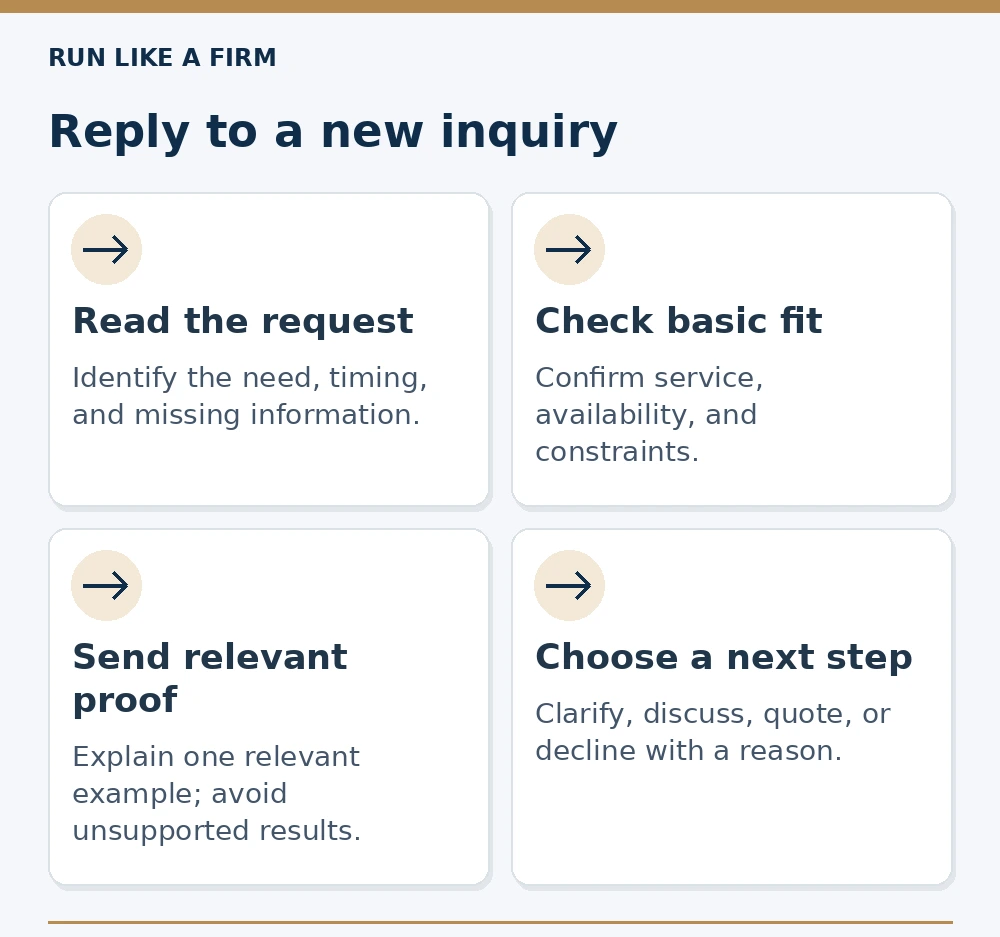
Read the decision map as text
- Read the request: Identify the need, timing, and missing information.
- Check basic fit: Confirm service, availability, and constraints.
- Send relevant proof: Explain one relevant example; avoid unsupported results.
- Choose a next step: Clarify, discuss, quote, or decline with a reason.
Choose the next step before writing the reply
Read the inquiry for four things: the requested help, the intended timing, the information already supplied, and the decision the client is asking you to make. Then choose a response that fits the situation.
| What the inquiry contains | Useful next step | What to avoid |
|---|---|---|
| Clear service request and enough detail to estimate | Confirm assumptions and prepare an estimate | Requiring a call merely because it is your default |
| Relevant need but vague scope | Ask for the missing information | Quoting a precise project fee from a label such as “website” |
| Complex problem requiring investigation | Explain a bounded discovery step | Giving away an extensive custom diagnosis in the first reply |
| Work you cannot deliver on the required date | Offer a feasible alternative or decline | Saying yes and hoping the schedule becomes easier |
| Service outside your expertise | State the mismatch and, where appropriate, suggest a route | Pretending you can handle everything |
The first message is not the full qualification process. It is an invitation to the next useful decision. For a straightforward editing request, that may be reviewing a document. For a complex operational problem, it may be a discussion about discovery.
Use the fit questions in our guide to qualify a freelance client when the inquiry needs more assessment.
Answer the actual question before asking your own
If the client asks whether you provide a service, answer that directly. If they ask about availability, give the window you can responsibly offer. If they ask for pricing, explain what pricing information is available at this stage.
An evasive reply creates unnecessary work. “Let's jump on a call” is not a useful answer to every request for a price or service detail. Equally, supplying an unsupported price just to appear responsive can create a commitment you cannot maintain.
Use a short structure:
- Acknowledge the specific request.
- State relevant fit, availability, or pricing information.
- Ask only for the facts needed next.
- Explain what you will do after receiving them.
If your acknowledgment is automated, make that clear. Do not imply that you have reviewed a brief when only an inbox rule has run.
A complete inquiry: answer the information already supplied
Hypothetical exchange; the rate is illustrative, not a market benchmark. The editor has checked the attached sample and their capacity before replying.
Subject: Copyediting a 2,000-word article for November 12
Hi, I have a 2,000-word article needing light copyediting for grammar and consistency, not rewriting or fact-checking. I’ve attached the current draft and sample. Can you deliver by November 12, 2026, and what would it cost?
Subject: Re: Copyediting a 2,000-word article for November 12
Thanks for the draft and sample. I can provide the light copyedit described and currently have capacity to deliver by November 12, 2026, at 3:00 p.m., America/New_York. My illustrative rate for this example is USD 80/hour. Having reviewed the supplied sample, I estimate two to three hours, or USD 160–240 before any applicable tax; this is an effort estimate, not a fixed quote.
I would return tracked edits and a clean copy, with one consolidated clarification pass on those edits. Rewriting and fact-checking stay outside this scope. If that approach works, please confirm it and the actual payment/tax arrangements before I reserve the slot. I will obtain authorization before exceeding the three-hour limit. A call is unnecessary unless you have a point that needs discussion.
The reply answers price and availability, acknowledges the actual draft and scope, and asks for a decision rather than requesting the word count or deadline again. In a real message, replace the teaching rate and availability with your checked terms.
Example: a relevant inquiry with a vague brief
The following messages are fictional teaching examples. Replace the details with your actual service and availability.
Subject: Re: Service-page copy inquiry
Thanks for getting in touch about the service-page copy. I can help with that. Before I estimate the work, please send the page list, the intended launch date, and any existing copy or brief. Once I review those, I can confirm the scope and whether a short discovery conversation would be useful.
This reply names the work, requests a small set of relevant inputs, and explains what happens next. It does not make the client complete a long questionnaire before you have established basic fit.
If the original inquiry already includes those facts, do not ask for them again. Refer to the supplied information and clarify the specific ambiguity. A template is useful only when you adapt it to the message in front of you.
When the need requires a conversation, prepare a focused freelance discovery call rather than a general sales chat.
What to say when the client asks for your price immediately
You can share an established hourly rate, starting fee, or typical range when it accurately describes your service. State what it covers and whether it is an indication or a quote for this project.
Copy-and-customize template: Replace the text in square brackets with your project details before using it.
Subject: Editing rate and estimate inputs
My editing rate is [your actual rate] for the service described here. For a fixed project estimate, I need the document length, the type of editing, and the required delivery date. Please send those details and a short sample so I can check the work involved.
For unfamiliar work, say what prevents a responsible estimate:
I cannot give a reliable fixed price from the app description alone. The integration requirements and existing data will affect the work. Please send the current specification; I can then confirm what can be estimated and what needs investigation first.
Avoid inventing a starting price to move the conversation along. A broad range with no assumptions can be just as misleading as a precise number.
Bryn Taylor's freelance email examples show one approach to sharing rates and availability early. That is useful where you already know those details; it does not mean every inquiry supports a project quote.
Send relevant proof instead of a portfolio dump
Choose one example that helps the buyer assess the requested work. Explain the similarity and the limits.
This example shows a service-page structure for a consultancy with a similar offer. It demonstrates the approach to explaining the service; it does not establish what results your business would achieve.
If the example is a demonstration rather than client work, label it. If you cannot disclose a project, do not imply confidential evidence proves your claim. You can explain your process or share an authorized sample instead.
The goal is to reduce the effort required to interpret your experience. Ten unexplained links can leave the client doing the work of identifying which one matters.
After discovery, turn the confirmed need into a client problem statement before recommending work.
Example: you are interested but not available immediately
Copy-and-customize template: Replace the text in square brackets with your project details before using it.
Subject: Presentation design — next available start
I can help with the presentation design, but my next production opening is [actual date]. If that fits your launch plan, please send the slide count, current content, and review requirements. If you need delivery earlier, I will not be able to commit to this version of the project.
Give actual dates and a time zone when timing depends on a particular working window. Do not describe yourself as available until you have checked other commitments. A possible opening and a reserved production slot are different things.
If the client accepts your availability, confirm what must happen before you reserve the work, such as an agreed scope and signed engagement. Use your real terms rather than copying someone else's deposit policy.
Example: the request is not a fit
Copy-and-customize template: Replace the text in square brackets with your project details before using it.
Subject: Re: Project inquiry — service fit
Thanks for explaining the project. The requested financial modeling is outside the services I provide, so I would not be the right person to deliver it. A specialist with experience in [relevant area] would be a better next step.
Offer a referral only if you have a suitable person or resource and can share it appropriately. Do not invent a recommendation to make the rejection sound helpful.
You can also decline a particular deadline while remaining open to a later version. State the constraint without a long defense or an unsupported judgment about the client.
How much should you ask in the first message?
Ask the smallest set of questions that changes the next step. For many service inquiries, the requested output, timing, and available inputs are enough to begin. Other work may require clarifying budget or decision ownership immediately.
Too few questions can produce an unsuitable call. Too many can make a simple inquiry feel like unpaid administrative work. Use the project's complexity, not a universal question count.
If you need several details, make them easy to answer in a short list. Explain why a difficult request matters: “A sample export will help me check whether migration can be estimated.” That is more useful than asking for access without context.
Keep the conversation from disappearing
Record the inquiry, the response date, the requested information, and the next follow-up point in a place you actually use. A spreadsheet can be enough for a low volume of inquiries. A CRM becomes useful when ownership and follow-up become harder to maintain.
If the client does not reply, follow up at a reasonable interval that fits the conversation. Refer to the outstanding decision. Avoid repeatedly sending “just checking in” or treating silence as proof of rejection.
If you close an inactive inquiry, keep the status accurate. Closed for no response is different from declined, lost to a competitor, or postponed.
Check the reply before sending
Can the client identify what you can help with? Have you answered their question? Are your dates and pricing statements accurate? Is the request easy to answer? Have you explained what happens next?
For your next inquiry, write the reply around that next decision. Include enough substance for the client to move forward, and save detailed diagnosis for the stage where it belongs.