
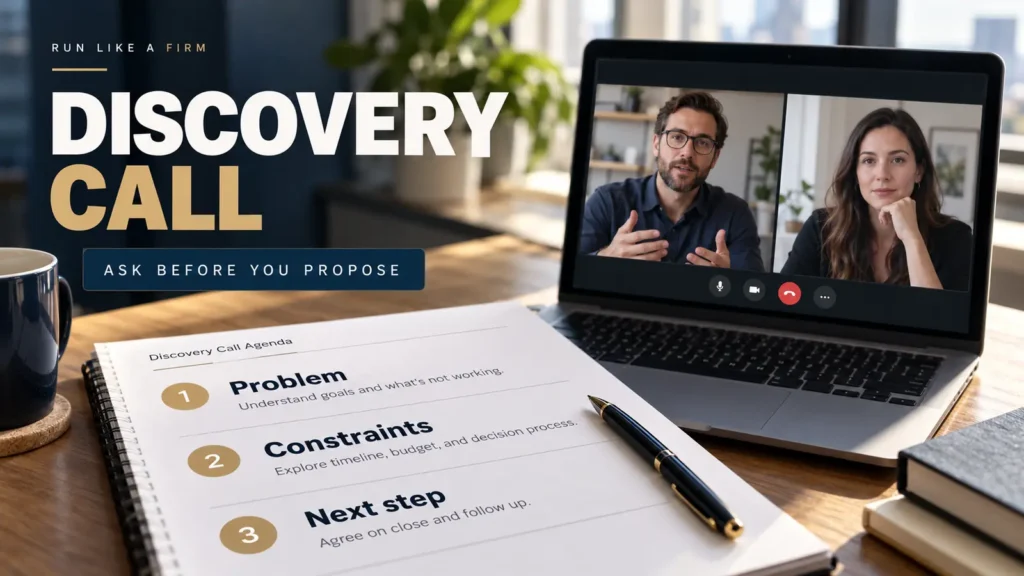
A freelance discovery call is an initial conversation that helps you understand a prospective client's problem, constraints, and decision process. Its useful output is an agreed next step supported by what you learned—not a long list of answers or an immediate promise to solve everything.
For straightforward work, that next step may be a proposal. For a complex or uncertain project, it may be a bounded paid assessment, a request for evidence, or a referral.
Qualification decides whether to advance an inquiry. Discovery explores the work in enough detail to decide what to recommend.
If the basic fit is still unclear, qualify prospective clients before committing to detailed discovery.
Prepare a few facts and a few hypotheses
Review the inquiry and any relevant public material: the website, offer, audience, or example of the current process. Do not confuse your observations with established causes.
For example, “The inquiry form has twelve fields” is an observation. “The form is causing lost inquiries” is a hypothesis unless you have supporting evidence.
Write down what you already know, what you suspect, and what you need to ask. This keeps preparation from becoming an unpaid audit.
Send an agenda explaining the purpose. A suitable invitation might say:
We'll discuss what prompted the project, what success would look like, and the constraints on delivery. We'll finish by deciding whether a proposal, further investigation, or another route makes sense.
Use an agenda that fits the project's complexity
The following 30-minute agenda is an example, not a recommended duration for every engagement.
| Part | Illustrative time | Useful output |
|---|---|---|
| Confirm purpose and context | 3 minutes | Shared understanding of why you are meeting |
| Explore the problem and desired change | 12 minutes | A preliminary problem statement and supporting examples |
| Discuss constraints and decision process | 10 minutes | Important dependencies, boundaries, and buying requirements |
| Summarize and agree the next step | 5 minutes | A specific action with an owner and date |
If an important issue needs more time, agree another step. Running beyond the agenda without checking availability is not evidence of a successful call.
Learn what prompted the request
Begin with the client's situation, not a tour of your services.
Useful discovery questions include:
- “What happened that made this a priority now?”
- “Can you show me a recent example of the problem?”
- “What have you already tried, and what happened?”
- “What would a useful result look like to you?”
Follow the answers. If the client says response times are slow, ask which step is slow and how they know. If they say the website “does not convert,” clarify what conversion means and whether they have trustworthy measurement.
Identify the constraints that can change your recommendation
A technically sound idea may be unsuitable if the client cannot supply essential inputs or operate it afterward.
Explore constraints relevant to the project:
- Required dates and the reasons behind them.
- Available budget or the process for authorizing it.
- Systems the solution must work with.
- People needed for content, access, reviews, and final decisions.
- Capacity to maintain the work after handoff.
Ask about the decision process without assuming your contact lacks authority. “Who else needs to evaluate this?” is usually more useful than a confrontational demand to speak to “the real decision-maker.”
HoneyBook's discovery guide and HubSpot's discovery-call guidance both address preparation, questions, and follow-up. Their advice is useful context; your recommendation still needs to fit the specific service and client.
Use a separate problem-diagnosis process when competing explanations could change the recommendation.
Distinguish a statement from evidence
Suppose a fictional client says: “We need a new CRM because leads disappear.”
You learn that inquiries arrive through email and a form, several people reply, and nobody consistently records the next action. That suggests a handoff problem. It does not yet prove a new CRM is necessary.
Your notes could separate the findings this way:
| Finding | Status | What to do with it |
|---|---|---|
| Client reports missed follow-ups | Client statement | Request a few recent examples |
| Two inboxes receive inquiries | Confirmed in the conversation | Check who owns each intake route |
| Missing ownership causes the losses | Working hypothesis | Trace examples before recommending software |
| A new CRM will fix the problem | Unverified solution claim | Do not put this promise in a proposal |
The next step may be a small process review, a CRM trial, or both. Choose it after examining the evidence you actually have.
Turn answers into a decision, not a longer question list
Suppose a fictional client wants a booking website. Their answers establish that they need one appointment type, have approved content, and can nominate a reviewer. If the integration is familiar and the requirements are clear, a project proposal may be a reasonable next step.
Now change one fact: the booking system must connect to an unfamiliar internal platform, and nobody can confirm the access available. The same request needs a technical check before you commit to implementation.
The decision rule is simple:
| What the call establishes | Appropriate next step |
|---|---|
| Bounded requirements and sufficiently understood delivery conditions | Prepare the project proposal |
| A specific missing fact the client can supply | Request that fact and explain why it matters |
| Investigation requiring substantial expertise or access | Scope a paid discovery phase |
| A decisive capability, timing, or working-condition mismatch | Decline this version or refer it |
Do not turn every open question into paid discovery. A missing invoice address needs clarification; an untested integration may need investigation. The difference is the work required to reach a responsible recommendation.
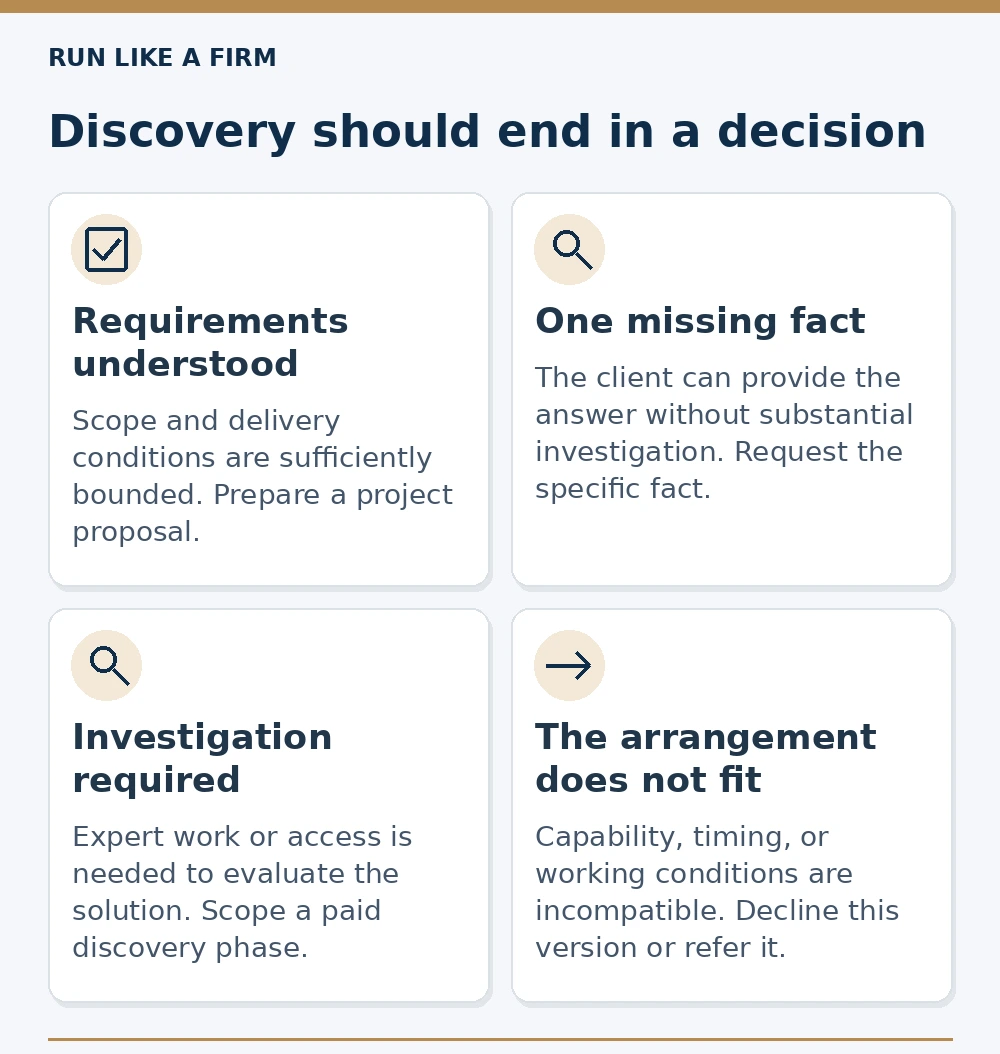
Read the decision map as text
- Requirements understood: Scope and delivery conditions are sufficiently bounded. Prepare a project proposal.
- One missing fact: The client can provide the answer without substantial investigation. Request the specific fact.
- Investigation required: Expert work or access is needed to evaluate the solution. Scope a paid discovery phase.
- The arrangement does not fit: Capability, timing, or working conditions are incompatible. Decline this version or refer it.
Use what you learned to choose a proportionate next step. An initial call does not need to produce a full implementation plan.
Give useful direction without delivering the full project for free
You can explain how you would investigate a problem, identify a likely risk, and help the client understand their options. You do not have to design the whole solution during an initial sales conversation.
If they ask for a detailed architecture, analysis, or implementation plan, define a paid discovery phase with its own scope and output.
For example:
For the booking project, I can propose a separate feasibility assessment after the platform owner supplies documentation. It would review that documentation, trace one agreed booking route in a permitted test environment, and deliver a short findings note: supported connection options, access gaps, assumptions, risks and a recommendation to proceed, investigate further or stop. It would not build the production integration, migrate records, redesign the website or guarantee compatibility.
Before accepting that assessment, agree the fee, effort boundary, required access, handling of test data, delivery date and reviewer. If access is unavailable, the output records that limit rather than claiming feasibility was proved. A findings note is complete when it addresses the agreed questions and names the unresolved ones; it need not conclude that implementation is possible. Do not use “paid discovery” to charge for basic information about your own service.
After the call, turn confirmed notes into a client problem statement before recommending a solution.
Close with the decision the call supports
Use the decision table above to choose the next step; do not repeat every question in the follow-up.
Summarize your understanding and invite correction before choosing. The client should recognize their situation in the summary.
A useful follow-up recap can be as simple as:
What we understand: one appointment type needs to reach the internal platform without manual re-entry.
What remains unverified: whether an authorized, supported connection is available.
Next action: the client contact requests the platform documentation from its owner by November 3, 2026, 3:00 p.m., America/New_York. I will review the supplied information by November 5 and confirm whether a bounded assessment is needed. No implementation commitment is made yet.
Before recording a meeting or using transcription software, establish an appropriate arrangement with the participants and check the requirements that apply to the engagement. Handle their information appropriately. A transcript is supporting material, not a verified diagnosis.
Turn sufficiently supported findings into a project proposal; keep unresolved assumptions visible.
Discovery call notes worksheet
Copy the fields below into your client record. Use them to turn the conversation into a decision; leave an answer marked “unconfirmed” when the client has not supplied evidence.
Client / project: [Name]
Call date: [Date]
Client goal: [Desired change and how success will be assessed]
Current problem: [What happens now, for whom, and when]
Evidence: [Examples or records reviewed; distinguish client reports from verified facts]
Constraints: [Timeline, access, capacity, dependencies]
Decision process: [Who recommends, approves, and supplies inputs; route to authorization]
Budget context: [Available range or authorization process; mark unknowns]
Open questions: [Missing fact / why it matters / owner / due date]
Next step: [Proposal / clarify / paid assessment / decline or refer]
Action owner and date: [Person / action / due date]
Worked example: a booking website with an untested integration
Hypothetical call, October 29, 2026. This continues the booking scenario above; it is not a customer result.
Freelancer: What should happen after someone requests an appointment?
Client: The booking should appear in our internal platform. At present, staff copy it from an email.
Freelancer: Is there a supported connection, and who can authorize access to its documentation and test environment?
Client: I do not know. Our platform owner can check; I can ask them.
Freelancer: Let’s request that documentation first. If feasibility still needs investigation, I will propose a bounded assessment. A full implementation quote would assume a connection we have not established.
- Client goal
- Let visitors book one appointment type without emailing the team.
- Current problem
- The client reports that staff manually transfer booking requests into an internal platform.
- Evidence
- The client has shown the current booking form. The platform connection has not been inspected; missed bookings and their cause remain unverified.
- Constraints
- Approved content is available. Implementation depends on access to an unfamiliar internal platform.
- Decision process
- The client contact will nominate the final reviewer; the platform owner must confirm access.
- Budget context
- Implementation budget is not yet confirmed. Any assessment would need a separately approved scope and fee.
- Open questions
- Can the platform accept bookings through a supported connection? The client contact requests documentation from its owner by November 3, 2026, 3:00 p.m., America/New_York. The freelancer reviews it by November 5.
- Next step
- Request the documentation first. If deciding feasibility requires technical investigation, scope a paid assessment before offering implementation.
The record supports a request for evidence now. Update the next step after that evidence arrives; the worksheet does not authorize implementation or establish the cause of missed bookings.
Review the call before writing a proposal
Can you explain the problem without merely repeating the requested deliverable? Are important constraints clear? Do you know how the client will evaluate a recommendation? Have you named the remaining uncertainties?
If not, resolve the uncertainty that matters. If yes, turn the findings into a defensible recommendation and a proposal the client can evaluate. A friendly conversation is useful, but the real test is whether it produced a better next decision.