

Qualify a freelance client by checking the need, scope, buying process, and delivery conditions before committing substantial presales time. Choose one of three next steps: proceed, clarify a specific uncertainty, or decline the arrangement.
A missing budget or an early-stage brief does not automatically make someone a bad client. The useful distinction is between an unknown you can resolve and a mismatch that makes the work unsuitable.
Decide what you need to know at this stage
Qualification comes before detailed diagnosis and proposal writing. You need enough information to justify the next step, not a complete business strategy.
For a first inquiry, establish:
- What help the client wants and why they want it now.
- Whether the work falls within your capabilities.
- The approximate scope and deadline.
- How the buying decision and budget will be handled.
- Whether essential inputs and working arrangements are feasible.
A simple project might require an email exchange. A complex engagement may justify a short conversation followed by paid discovery. Do not turn every inquiry into the same lengthy process.
Once an inquiry is worth advancing, use a freelance discovery call to explore the problem and delivery conditions.
Ask questions that change your decision
Adapt these screening questions to your service. Use the answers to choose a next step, rather than assigning an artificial client-quality score.
| Area | Useful question | What the answer helps you decide |
|---|---|---|
| Need | “What needs to be different when this work is finished?” | Whether the request matches what you can help achieve |
| Scope | “What is included in the first version?” | Whether the initial work is bounded enough to discuss |
| Timing | “What makes that deadline important, and what must happen before work starts?” | Whether the date is feasible and which dependencies matter |
| Budget | “Is there an approved range, or do you need help defining a smaller first step?” | Whether to scope a proposal, clarify investment, or offer discovery |
| Authority | “Who will approve the work and authorize the engagement?” | Whether the contact can involve the necessary people |
| Participation | “Who can supply the materials and consolidate feedback?” | Whether delivery can proceed with workable client input |
Ask follow-up questions where the answer affects the project. Avoid treating the table as an interrogation script.
Upwork's project-scoping guidance similarly encourages clients to clarify goals, milestones, timing, and review expectations. Its guidance is written from the hiring side; the questions above adapt the underlying scoping task to the freelancer's decision.
What to do when the client will not share a budget
A missing budget is a question to resolve, not a reason to guess the client's financial position. You can describe a realistic starting range for your own service if you have established one, ask which scope they are considering, or explain what information you need before estimating.
For example:
I can estimate this once we confirm the first-release page list. If you have an approved investment range, sharing it will help me suggest a workable scope. If not, I can explain the options after reviewing the requirements.
Avoid providing an extensive custom plan merely to discover whether the client can act. Agree the next commitment before increasing the presales work.
If they will not share a budget but will discuss a bounded scope, an estimate can still be appropriate. If they also refuse to clarify the requirements or decision process, you lack the conditions needed for a responsible proposal. Explain the missing condition and pause that next step.
Separate uncertainty from incompatibility
“We do not have a budget yet” can mean several things. The client may be comparing options, waiting for authorization, or unable to fund the work. You cannot identify which from that sentence alone.
Similarly, a contact who is not the decision-maker may be a useful internal sponsor. The important question is whether there is a path to an authorized decision.
Use a proportionate response:
| Situation | Decision | Next step |
|---|---|---|
| Relevant need, feasible scope, workable buying process | Proceed | Schedule discovery or prepare a suitable estimate |
| Promising need, but an important condition is unknown | Clarify | Request the specific information that changes the decision |
| Feasible need, but diagnosis would require substantial work | Offer a paid first step | Define what that discovery engagement will deliver |
| Required deadline cannot be met, even after discussing alternatives | Decline this version | Explain the constraint and offer a feasible alternative if one exists |
| Client insists on conditions you cannot responsibly accept | Decline | State the mismatch briefly and close the inquiry |
Do not average away a decisive constraint. A good budget cannot compensate for a deadline you know you cannot meet.
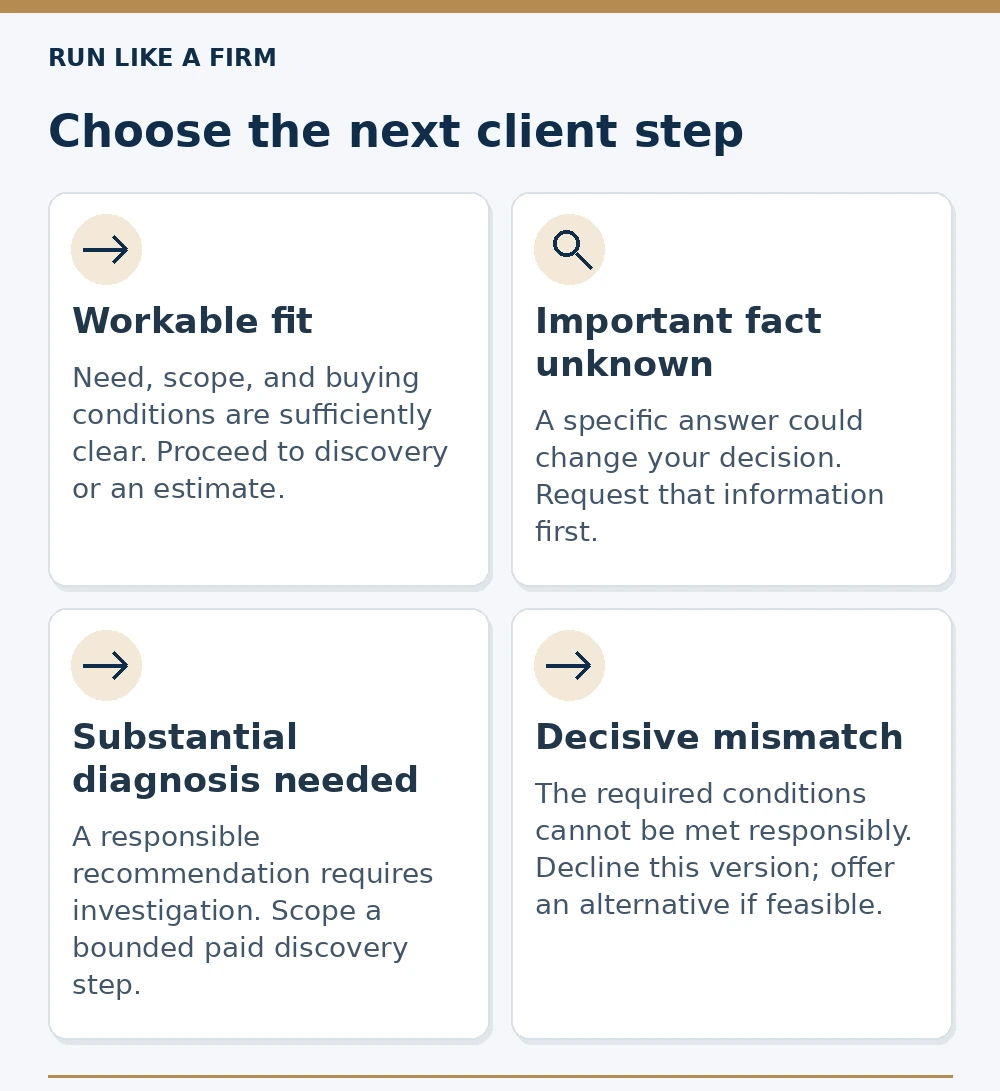
Read the decision map as text
- Workable fit: Need, scope, and buying conditions are sufficiently clear. Proceed to discovery or an estimate.
- Important fact unknown: A specific answer could change your decision. Request that information first.
- Substantial diagnosis needed: A responsible recommendation requires investigation. Scope a bounded paid discovery step.
- Decisive mismatch: The required conditions cannot be met responsibly. Decline this version; offer an alternative if feasible.
Choose the next step from the evidence available; do not assign a client-quality score.
State your working conditions before judging the response
Clients cannot respect an arrangement they have not been told about. Explain the relevant conditions: how revisions work, how approval is handled, when payment is required, and what information you need to start.
Then observe whether the prospect is willing to discuss them.
There is a meaningful difference between “How does your revision process work?” and “I expect unlimited revisions regardless of what we agree.” The first is a reasonable question. The second may establish a mismatch after you explain the alternatives.
Qualification also runs in both directions. A client can reasonably ask about your availability, relevant examples, limits, and delivery process. Your willingness to answer helps them evaluate you.
If lead records and next actions are difficult to maintain, use the CRM selection guide to assess whether a different setup would help.
Watch the cost of advancing an uncertain lead
Use simple time accounting rather than a speculative lead-quality score.
Illustrative calculation: a prospect has required 25 minutes of email, a 30-minute call, and 65 minutes of preliminary proposal work. That is 120 minutes, or two hours. At an internal planning rate of $55 per hour, the time is valued at $110 for planning purposes.
That is not a cash loss or proof you would have sold those hours elsewhere. It is a way to see how much attention you have committed. The rate is an assumption, not a market benchmark.
Before adding another hour, ask what new evidence would justify it. If you are still waiting to learn whether the client can authorize the project, more proposal detail may be the wrong next investment.
Record presales time over several inquiries if this is a recurring concern. You can then compare your own patterns without pretending every lead has a predictable value.
Work through three realistic situations
These examples are fictional.
The undefined website request. A client wants a “better website,” has no page list, and is unsure about budget. Clarify the goal and propose a bounded paid audit if understanding the scope requires significant investigation. Do not assume they are wasting your time.
The urgent campaign. The client has a clear brief and funding, but the assets arrive after the production deadline. Discuss reducing the first release or moving the date. If neither is acceptable, decline the requested arrangement.
The capable internal sponsor. A marketing manager understands the problem but needs a director's approval. Proceed to an appropriately sized next step if the approval path is clear. Ask when and how the director will participate before investing in a full proposal.
When the work is sufficiently understood, a project proposal can make the scope and commercial decision reviewable.
Start the process with a clear first reply to a client inquiry before moving into detailed qualification.
Close with a concrete next step
For clarification:
This looks relevant to my work. Before I recommend the next step, please confirm the first-release requirements and who can approve the engagement. Those answers will determine whether I can quote the project or whether we need a discovery phase.
For a decline:
I cannot meet the required delivery date with the inputs available. I can offer a later start or a smaller first release. If neither works, I am not the right fit for this version of the project.
You do not need to label the client difficult or defend your standards at length.
Qualification decision record: record the evidence
Copy one record per inquiry. Mark each condition Confirmed, Unknown or Mismatch for the next commitment, with its evidence. Confirmed means supported and workable for that step, rather than guaranteed for the whole project. A decisive mismatch cannot be offset by other confirmed conditions.
Opportunity / review date:
Need: [Status / intended change]
Scope: [Status / initial boundary and capability fit]
Timing: [Status / deadline, capacity and dependencies]
Budget context: [Status / range or funding route]
Authority path: [Status / sponsor, approver and route]
Inputs: [Status / material, access and feedback owners]
Payment / working conditions: [Status / requirements discussed]
Evidence: [Answer, document or observation / source / date]
Unknowns: [Question that could change the decision]
Decision: [Proceed / Clarify / Decline this arrangement]
Next action:
Owner / required-by / review date:
Completed record: an urgent campaign with late assets
Hypothetical inquiry, reviewed October 28, 2026. A copywriter is asked to prepare three campaign emails for a fixed November 6 send. This is a screening decision, not an accepted delivery plan.
- Need — Confirmed
- Explain the client’s seasonal offer in three emails. Source: marketing manager’s inquiry, October 27.
- Scope — Confirmed
- Three emails using approved offer facts; within the copywriter’s service. Source: inquiry and capability check, October 28. Detailed acceptance and reviews would follow only if timing is workable.
- Timing — Mismatch
- Approved offer facts arrive November 5, after the copywriter’s last feasible production and review window. Source: manager’s October 28 email and the copywriter’s capacity calendar.
- Budget context — Confirmed
- The manager confirms a funded range compatible with the preliminary scope. Source: October 28 reply. This is not yet an agreed quote.
- Authority path — Confirmed
- The marketing manager sponsors the work and can route the proposal to the director who authorizes spending. Source: manager’s October 28 reply; direct access to the director is not required for this screening step.
- Inputs — Confirmed; timing incompatible
- The product owner supplies approved facts November 5; the manager consolidates feedback. Named ownership does not solve the late dependency.
- Payment / working conditions — Unknown
- Invoice due dates and revision arrangements have not been discussed. Resolve them before any engagement commitment if a viable schedule is found.
- Evidence and unknowns
- Inquiry, dated manager replies and the capacity calendar are linked in the lead record. The unresolved decision is whether the client can bring inputs forward, reduce the release or move the send date.
- Decision, next action and owner
- Clarify before drafting a proposal. The copywriter sends those three alternatives October 28; the marketing manager responds by October 29, 2026, 3:00 p.m., America/New_York.
Recorded follow-up: In this fictional example, the manager’s October 29 reply rules out all three alternatives. The copywriter updates the decision to Decline this arrangement, closes the promised follow-up that day and explains the timing constraint. Budget and sponsor access cannot make the incompatible delivery date feasible.
This is a practical decision aid, not a validated prediction of client behavior or project success. Recheck it when scope, timing or authority changes.
Before you say yes
Make sure you can explain why this opportunity is worth advancing, what remains unknown, and which next action will resolve it. Put that action and its date in your lead record.
Qualification is complete for the current stage when you have enough evidence to choose the next step. Detailed discovery should then deepen your understanding of the problem—not repeat a screening conversation indefinitely.