

Write a service business case study by explaining the client's starting situation, the decision behind the work, what you delivered, and what the evidence shows changed. Give buyers enough context to judge whether the case applies to their own needs.
A large percentage with no baseline is weak proof. A modest, documented result with clear conditions can help a buyer assess the work more responsibly.
Use real project evidence for a client case. The fictional illustration in this guide demonstrates structure; it is not a client result or testimonial.
Use the questions buyers ask about your service offer to select a relevant case.
Choose the buyer question first
Decide what the case should help a suitable prospect evaluate.
For example:
- Can this provider handle a similar project?
- What does the engagement require from the client?
- Why was this approach chosen over an alternative?
- What evidence exists for the reported change?
- Under which conditions might the result be relevant elsewhere?
A case that answers one meaningful question is more useful than a collection of impressive but unrelated achievements.
Choose a project with sufficient evidence and appropriate permission. A recognizable client name cannot compensate for a story you are not allowed to publish or a result you cannot verify.
Collect the evidence before writing the success story
Gather the original objective, relevant baseline, agreed work, delivered output, measurement method, period, and client confirmation where available.
Keep different evidence types separate:
| Evidence | What it can support | What it cannot establish alone |
|---|---|---|
| Approved deliverable and test record | The specified work was delivered and checked | Revenue or retention improvement |
| Before-and-after operational records | An observed change under the stated conditions | That your work was the only cause |
| Client quotation | The client's reported experience | An independently measured result |
| A screenshot without context | What the screen displayed at that moment | A comparable period, representative sample, or causal effect |
| Provider estimate | A transparent planning calculation | A measured client outcome |
Do not build the narrative around a metric until you know what the metric actually measures.
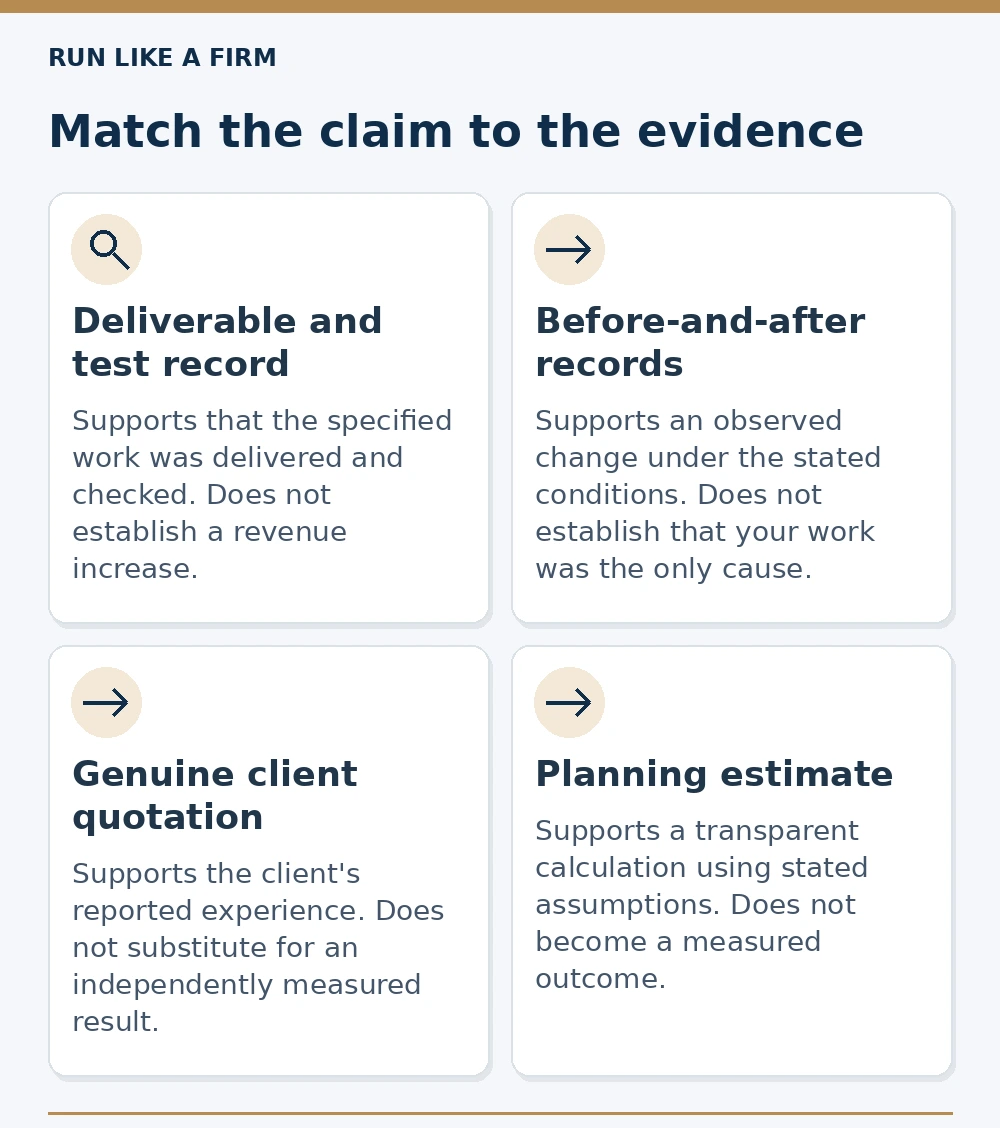
Read the decision map as text
- Deliverable and test record: Supports that the specified work was delivered and checked. Does not establish a revenue increase.
- Before-and-after records: Supports an observed change under the stated conditions. Does not establish that your work was the only cause.
- Genuine client quotation: Supports the client's reported experience. Does not substitute for an independently measured result.
- Planning estimate: Supports a transparent calculation using stated assumptions. Does not become a measured outcome.
Different evidence supports different conclusions. If client evidence is unavailable, publish a labeled demonstration rather than an invented result.
Explain the situation and the choice
Give enough context to understand why the engagement existed: the relevant business type, team, current process, constraints, and specific problem.
Then explain the chosen approach. What evidence supported it? Which alternatives were considered? What made the work suitable for this client?
You do not need to expose confidential strategy or a complete implementation playbook. Describe the meaningful decisions and public-facing application while respecting the agreed boundaries.
Show the work without narrating every task
Describe the parts that connect the starting problem to the result. A case study is not a timesheet or a full account of every revision.
For a workflow project, that might mean explaining how ownership was clarified, the agreed routes were configured, and sample scenarios were tested. It does not require copying the entire private operating system into the article.
Include obstacles when they help a buyer assess the work. If the client needed to allocate a reviewer, provide clean data, or change an internal process, say so. An outcome presented as effortless can conceal the very conditions a future client must meet.
Report results with their limits
For every quantitative claim, identify:
- The baseline and comparison period.
- The unit and denominator.
- The source of the data.
- Relevant changes occurring at the same time.
- What the evidence does and does not establish.
If response time fell while staffing also increased, do not attribute the full reduction to your workflow alone. If the client reports improvement but has no comparable records, present it as reported experience rather than a measured percentage.
If you cannot verify a result, omit it or explain the limitation. A process case can still demonstrate how work was delivered without inventing a commercial outcome.
Write a useful case when you have no revenue result
A completed project can support a credible process case without a revenue claim. Explain the problem, the delivery decision, the agreed output, and how completion was checked. Make the limit explicit.
For example, a real page-copy case might show the approved before-and-after structure and the buyer questions each section addresses. It can demonstrate the writing and reasoning. Without comparable inquiry records, it cannot demonstrate an increase in leads.
If you are still waiting for outcome data, state the observation period and what will be assessed when it becomes available. Do not publish a projected result in a “Results” section as though it has occurred.
If you have no client project at all, publish a labeled demonstration or sample analysis. Keep it separate from client case studies and testimonials. A transparent sample can help a buyer evaluate your approach; disguising it as client evidence undermines the very trust the case is meant to build.
A complete fictional demonstration
Demonstration only: the consultancy, records and outcomes below are invented to show a finished process case. No customer result, testimonial or real test result is claimed. The example demonstrates how to describe operational work without revenue figures.
Making an inquiry handoff visible in a small consultancy
Context. A three-person consultancy receives requests through a website form and a shared inbox. The founder handles some inquiries; two colleagues help with others.
Problem and baseline. The team cannot reliably identify the next-response owner from its shared record. In the fictional October 1–28 review, the route map shows two intake paths but no agreed assignment rule or single place for the next action. The founder reports inconsistent follow-up. Historical response times and lost revenue are not measured, so neither appears as a proven baseline metric.
Decision. Before replacing the CRM, the team chooses a bounded handoff cleanup in its existing supported system. The decision follows the observed ownership gap; it does not assume that software age caused a sales decline. The engagement excludes acquiring leads, sales training and redesigning the website.
Work. The provider maps the two named routes, agrees one accountable owner and backup for each, configures the specified assignment/reminder behavior, and prepares a short operating guide. The client supplies authorized access and nominates an inbox owner to check receipt. Reviewers resolve conflicting ownership instructions before configuration is released.
Evidence. In the invented acceptance record D1, dated October 30, 2026, four labeled synthetic journeys cover the two agreed routes and their stated assignment cases. Each record identifies the route, test environment, expected owner, observed receipt, next action and reviewer. The four scenarios meet their specified checks in this teaching story. The evidence is an illustrated acceptance record, not actual Run Like A Firm test data or a statistical sample of client performance.
Outcome and limit. The story ends with a handoff that makes the responsible person and next action visible for the tested scenarios, plus a guide explaining what to do when assignment fails. It does not show fewer lost leads, faster average replies or higher revenue. Future monitoring must check real journeys, other material routes and environment changes before making broader claims.
Buyer relevance. The example helps a small team assess whether clarifying ownership in an existing system could be an appropriate first engagement. A buyer needing complex permissions, regulated-data controls or a new platform would need a different feasibility and scope assessment. The useful next question is whether their own records show this same gap—not whether the fictional outcome guarantees theirs.
Add buyer relevance and limits
Explain who might find the example applicable and who might not.
The fictional handoff case is relevant to a team with similar intake routes and unclear ownership. It says less about a large sales organization needing complex permissions, multiple pipelines, or regulated data handling.
Avoid universal conclusions such as “This approach works for any service business.” A case provides context-specific evidence, not a guarantee of transferable results.
A case study has a different purpose from an introduction; use the guide to ask clients for referrals for that request.
Obtain approval for the actual publication
HubSpot's case-study guide addresses candidate selection, permissions, and story structure. Agree what you can identify, quote, and show, then have the relevant client contact review the material before publication.
Do not assume project approval includes permission to publish confidential data. Anonymizing the company name may not be enough if screenshots or distinctive details identify it.
Extend the evidence checklist above with one publication-permission record for the actual version being released:
Case / publication version:
Client name: [Approved / not approved / anonymized]
Logo: [Specific asset and approved use, or omit]
Quotation: [Exact approved wording / attribution, or none]
Screenshots: [Approved images / required redactions, or none]
Publication scope: [Website page / social / proposal / other channels]
Approving contact / authority / date:
Conditions / exclusions / next review:
For this fictional demonstration, no client name, logo, quotation or customer screenshot is used and no customer permission is represented as obtained. For a real case, pending permission remains pending; omit material whose intended use has not been authorized.
Any quotation should be genuine and approved for its intended use. Do not write a testimonial and attribute it to a client who never said it.
A reader ready to evaluate an engagement may benefit from a project proposal that explains how the work is scoped.
Finish with a relevant next step
Invite the reader to evaluate whether their situation matches the case and what they need to clarify next. A link to a relevant service offer, diagnostic explanation, or proposal guide can help.
Before publishing, check whether a skeptical buyer could distinguish the observed result, your interpretation, and any remaining uncertainty. If they can, the case is ready to help them decide. If they cannot, improve the evidence or narrow the claim before polishing the story.