

To find client expansion opportunities, review what has changed in the client's business, confirm an unmet need, and check whether your service can address it profitably within your capacity. A new department, repeated workaround, or upcoming launch is a signal to investigate—not permission to sell more work.
Start with the current engagement. If an unresolved delivery problem is creating the apparent opportunity, repair that problem before discussing additional fees.
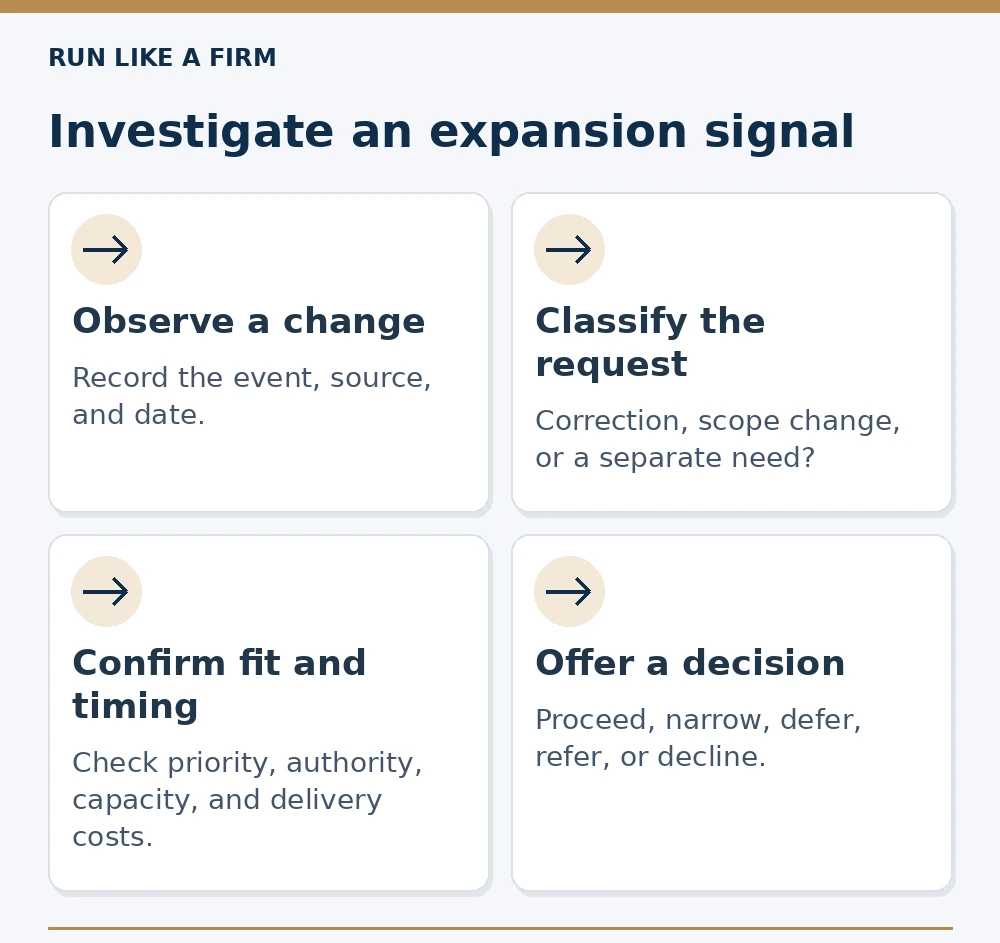
Read the decision map as text
- Observe a change: Record the event, source, and date.
- Classify the request: Correction, scope change, or a separate need?
- Confirm fit and timing: Check priority, authority, capacity, and delivery costs.
- Offer a decision: Proceed, narrow, defer, refer, or decline.
Investigate an expansion signal. Observe a change: Record the event, source, and date. Classify the request: Correction, scope change, or a separate need? Confirm fit and timing: Check priority, authority, capacity, and delivery costs. Offer a decision: Proceed, narrow, defer, refer, or decline.
Separate expansion from work you already owe
Three situations can look similar in a client conversation but require different responses.
| Situation | Example | Appropriate response |
|---|---|---|
| Correction | An agreed page is missing a required section | Complete the agreed work through your correction process |
| Scope change | The client wants another page in the current project | Review the change, its cost, and its effect on timing |
| New business need | Another department needs its own onboarding content | Investigate a separate engagement |
Use the written scope and acceptance criteria to decide which situation applies. Do not rename an unfinished obligation an expansion opportunity. Conversely, a positive relationship does not make unrelated work part of the original fee.
Review client retention and unresolved issues before treating the account as ready for additional work.
Look for observable changes
Review project discussions, feedback, support questions, and the client's stated plans. Record what you actually heard or saw, with its date and source.
Useful signals include a new audience, a new service, an upcoming launch, repeated manual work, a process that breaks between departments, or a result the client now wants to maintain. Your completed work may also reveal an adjacent problem that was outside the original scope.
Each signal needs a question. “We are opening a second location” might suggest onboarding work, but the client may already have a supplier or an adequate internal process. Ask what changes for their team and where they expect difficulty. Do not assume every change creates a buying need.
Build a short opportunity record
Keep one record per potential need. A paragraph in a shared document is enough if it can be found and updated.
| Field | What to record |
|---|---|
| Observed change | A specific event, request, or recurring issue |
| Evidence | Who reported it, when, and any supporting material |
| Possible consequence | What may happen if it remains unresolved; label assumptions |
| Existing response | What the client already does or has commissioned |
| Owner | Who experiences the problem and who can authorize work |
| Timing | When a decision is needed and why |
| Next step | A question, review, or meeting—not an assumed sale |
Avoid assigning an impressive-looking opportunity score when its inputs are guesses. A short list of confirmed needs is more useful than a long list of high scores without evidence.
When a new need is confirmed, scope a freelance project separately.
Confirm the need before designing the offer
Use a conversation to answer four questions:
- What has changed since the current work was agreed?
- Where is that change causing difficulty, and for whom?
- What is already being done about it?
- Is addressing it a priority now, later, or not at all?
Then clarify decision ownership and constraints. Your existing contact may be able to introduce the right person but may not control the budget. An introduction is a next step, not approval.
A practical opening is:
You mentioned that the second team will start using this process next quarter. Our current work covers the original team. Is the new team's setup already handled, or would a short review of the differences be useful?
This makes the boundary clear and leaves room for the client to say the work is unnecessary.
Check whether the opportunity fits your business
Client interest is only one part of the decision. Check that you can deliver the work, that it fits your expertise, and that the required resources are available.
Estimate delivery effort, outside costs, coordination, and likely dependencies before setting a price. Do not count an assigned labor cost twice when reviewing contribution. Also consider concentration: another large project from one account may make your revenue more dependent on that client.
If the need is outside your expertise, a relevant introduction may serve the relationship better than a weak offer. If your schedule is full, offer a realistic start date or decline. Do not promise capacity you have not checked.
Before proposing the expansion, align scope, price, and outcome with the appropriate decision-maker.
A worked expansion example
This is a hypothetical scenario, not a client result.
A consultant finishes an onboarding guide for a five-person service team. During handoff, the client explains that a newly acquired department will use different approval rules.
The consultant first checks the current scope: one team's process, one guide, and one training session. Correcting an error in that guide remains current work. Adapting it to the new department may be a separate need.
Before proposing a rollout, the consultant asks for the new department's process, its owner, and the intended start date. The review reveals that its approvals have not been decided. A full guide would be premature.
The useful next step is a bounded process review, if the client wants one. Its output is a documented set of differences and unresolved decisions. The client can then decide whether implementation is necessary. The consultant does not sell a larger package merely because the account could afford it.
Present the opportunity as a decision
Use this outline when the need is confirmed:
Copy-and-customize template: Replace the text in square brackets with your project details before using it.
Change: [What changed, with evidence.]
Need: [The problem the client confirmed.]
Proposed work: [Deliverables and boundaries.]
Dependencies: [Client inputs, approvals, and unresolved decisions.]
Commercial terms: [Price, payment structure, and realistic timing.]
Decision: [Proceed, narrow the work, revisit on a stated date, or decline.]
An optional additional phase should remain optional. Explain what the first phase achieves on its own and what would justify the next one.
Follow up without creating a second sales pipeline of guesses
Record the client's response and an agreed follow-up date, if there is one. When the client says the need is not a priority, close the opportunity or mark it for a specific later review. Do not send repeated reminders simply because the relationship is active.
Review whether your proposed work addressed the confirmed problem after delivery. That review can reveal another need, but each additional engagement requires its own decision. Expansion should build on useful work and clear agreement.
Frequently asked questions
When should I raise an expansion idea?
Raise it when you have a relevant observed change and the current engagement is in a condition that supports the conversation. A completed milestone can be useful timing, but it does not prove the client wants more work.
Is expansion the same as upselling?
Upselling usually means offering a larger version of an existing purchase. Expansion can also mean a new department, use case, or adjacent service. Either way, confirm the need and agree the scope separately.
What if the client expects the new work for free?
Compare the request with the current agreement. Explain what is included and what changes, then offer a priced option if appropriate. Resolve genuine ambiguity before treating the request as a sales opportunity.