
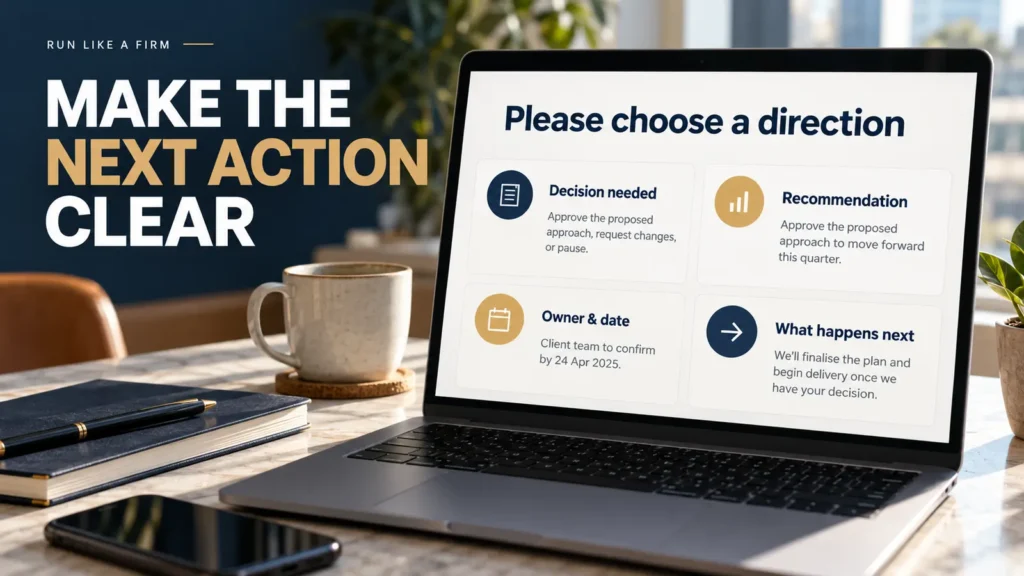
Client communication works when the reader can identify the current situation, understand what matters, and take the right next step. For freelancers, that means making requests specific, recording decisions, and agreeing how and when communication happens.
A shorter message is not automatically a better one. Remove the detail that distracts, keep the detail needed for the decision, and avoid reassurance that hides a real problem.
This guide covers everyday client messages, review requests, timing, and difficult conversations. Use a recurring project update when the client needs the wider delivery picture.
Put the reader's task near the top
Before writing, complete this sentence: “After reading this, the client needs to ___.”
Possible answers include approving a version, providing information, choosing between two approaches, or simply understanding progress. If you cannot name the task, reconsider whether the message needs to be sent yet.
Start with the purpose, then supply the context. For example:
Please choose the homepage direction by Thursday at 2 p.m. London time. I recommend Option B because it gives the main service a clearer position. The two options and the comparison are below.
The client can immediately see what the message requires. They can then read the reasoning at the depth they need.
Avoid hiding a request inside a paragraph about everything you have done. And if no action is required, say so. An informational message should not leave the client wondering whether they are blocking you.
Improve the message without removing the substance
The following examples are fictional and written to illustrate the editing choices.
| Situation | Message that creates uncertainty | Clearer alternative |
|---|---|---|
| Initial inquiry | “Absolutely, I can help with all of that. Let me know more.” | “I can help with the website copy. Before I estimate it, please send the page list, intended launch date, and who will approve the copy.” |
| Feedback request | “Thoughts on the draft?” | “Please review whether the examples reflect your service accurately. Add one consolidated set of comments to version 2 by Wednesday. Layout review comes next.” |
| Schedule risk | “Things are taking a bit longer, but we're making good progress.” | “The planned handoff is at risk because the product details are still missing. If they arrive by Tuesday, I can confirm the revised handoff date Wednesday.” |
| Conflicting instructions | “I'm confused about the changes.” | “The sales team requested a shorter form; operations requested more mandatory fields. Which requirement takes priority? Please confirm one direction before I revise it.” |
The improved versions are not better because they sound more confident. They identify the missing information or decision. They also avoid promising dates before the necessary inputs exist.
If the message concerns additional work, use the scope-change process to explain the options.
Include enough detail for an informed decision
A message can be too short. “Approve B today” is concise, but it may omit the trade-off the client needs to understand.
For a meaningful choice, include:
- The options that are actually available.
- Your recommendation and its reason.
- The main consequence of choosing each option.
- The decision owner and agreed review date.
Suppose a client wants a new feature before launch. A useful message might say:
We can keep Friday's launch with the agreed feature set, or add the export function and revise the delivery schedule after estimating it. I recommend keeping the launch scope because the export is not needed for the initial users. Which approach should I plan around?
Do not create a false choice if other options exist. If the information is incomplete, offer to clarify it before asking for approval.
Read the decision map as text
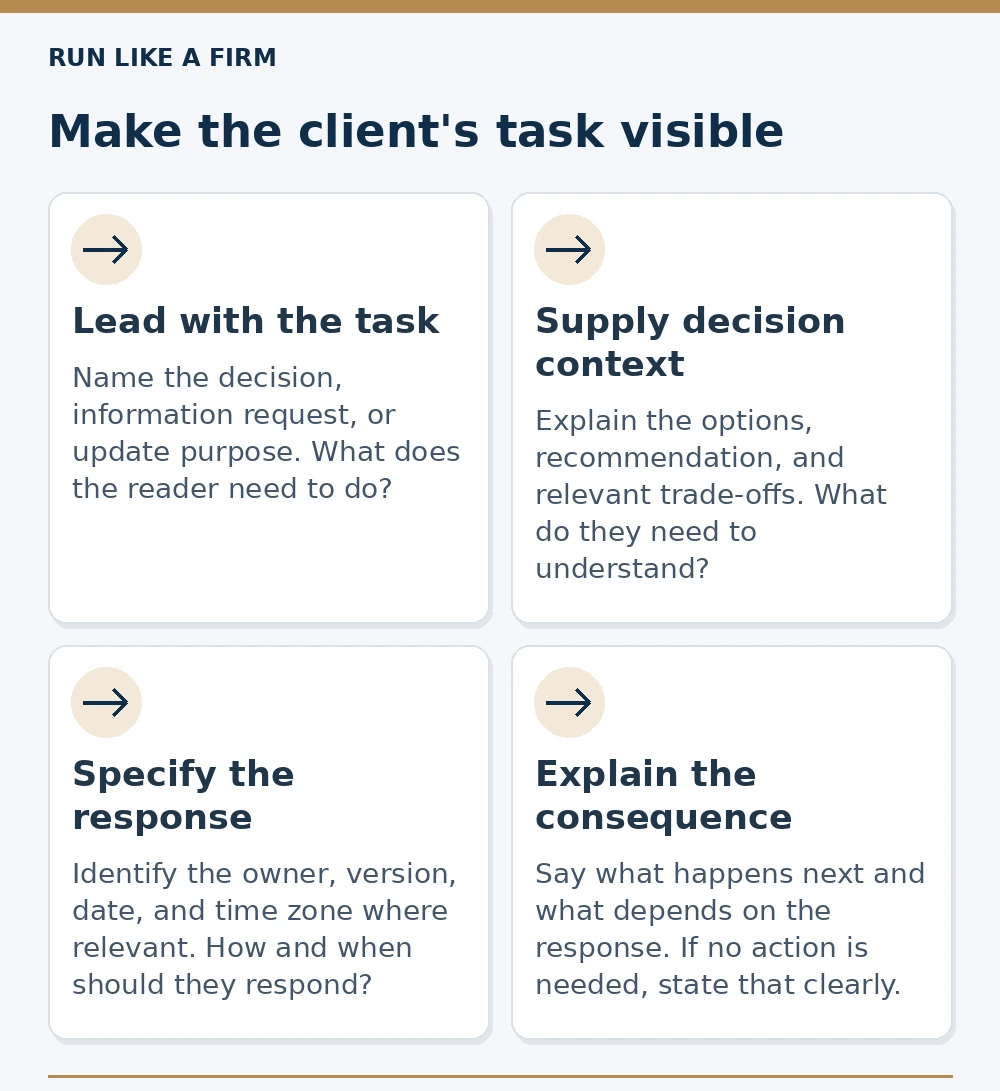
- Lead with the task: Name the decision, information request, or update purpose. What does the reader need to do?
- Supply decision context: Explain the options, recommendation, and relevant trade-offs. What do they need to understand?
- Specify the response: Identify the owner, version, date, and time zone where relevant. How and when should they respond?
- Explain the consequence: Say what happens next and what depends on the response. If no action is needed, state that clearly.
Structure a message around the action or understanding it needs to create. Keep enough detail to support the decision. Concision alone does not make a message useful.
Use the right channel for the situation
Routine updates and straightforward decisions often work well in writing. Sensitive disagreements, ambiguous feedback, and discussions involving several competing priorities may need a call.
The practical test is whether the chosen channel can carry the necessary context. A hurried chat message is a poor place to resolve a complicated scope disagreement. A meeting is unnecessary if the client only needs to confirm an invoice address.
After a conversation, record the decisions where both sides can find them. Include the version or deliverable affected. “Approved on the call” is less useful than a dated record stating exactly what was approved.
| Channel | Suitable use | Decision record | Access boundary |
|---|---|---|---|
| Project thread / email | A bounded question, request or notification with clear context. | Dated answer naming the item, version, owner and next action. | Include only the participants who need the project information; check recipients and attachment access. |
| Comments on the current document | Specific edits and consolidated specialist feedback. | Resolved comment plus an explicit approval record when required. | Reviewers access the correct version; editing access is granted only where needed. |
| Call / video meeting | Conflicting instructions, ambiguous feedback or a priority trade-off. | Written recap of the actual decision, authority, conditions and actions. | Invite relevant decision participants; agree any recording arrangement before recording. |
From conflicting messages to a recorded decision
Hypothetical example: on November 2, 2026, sales asks for a shorter inquiry form while operations requests more mandatory fields. “Make it simpler” is ambiguous, and the launch priority has changed from collecting a detailed brief to routing event inquiries. The provider sends this message:
Form v2 has conflicting instructions: sales wants fewer fields; operations needs routing information. Before I revise it, can the release sponsor join a short decision call with both reviewers on November 3 at 11:00 a.m., America/New_York? Please identify which information is essential at first contact. We will compare the choices with the approved first-release scope and record one direction.
In the fictional call, operations confirms that service type is needed for routing but a detailed project brief can follow later. Sales accepts that distinction. The authorized sponsor selects the shorter form with service type retained; any scope or cost effect still follows the agreed change process.
Decision record — November 3, 2026, 11:30 a.m., America/New_York: The release sponsor approves direction B for form v3: keep service type for routing and defer the detailed brief to follow-up. The provider updates v3 by November 4 at 3:00 p.m.; operations checks routing and sales checks the wording by November 5 at noon. Final release still requires the agreed approval checks. The project thread links the current version and records any unresolved condition.
The call resolved the trade-off; the written record makes it usable afterward. If the sponsor cannot authorize a direction, record the decision as pending and name the next action rather than treating the meeting as approval.
vcita's communication guide also recommends matching channels to message types and confirming decisions in writing. Those are practical principles; they do not establish that a particular tool will improve your results.
Make cross-border communication unambiguous
When you work with clients in the US, UK, or elsewhere, write deadlines with a calendar date and a named time zone. “Tomorrow afternoon” can describe different working windows to different people.
For example, write “Please send consolidated comments by October 22 at 3 p.m. London time,” then check the corresponding time in your own calendar. Do not assume the offset between London and New York stays identical throughout the year.
Agree the days you both treat as working days, especially around public holidays. If a response window runs only on business days, explain whose calendar applies when that matters.
For recurring calls, use a calendar invitation with the relevant time zone and check the displayed time before sending. For async work, identify the expected acknowledgment window and the next decision date separately.
Clear timing does not require constant availability. It requires commitments both parties can interpret and maintain.
Agree on response expectations instead of implying constant availability
Tell clients when and how they can expect a reply. Use real business hours and a time zone. Distinguish your acknowledgment time from the time needed to investigate an issue.
For example:
I check project email on business days and aim to acknowledge messages within one business day. If a question needs investigation, I'll confirm when you can expect a substantive answer. For agreed launch-day incidents, use the phone contact in the launch plan.
Only offer this if you can maintain it. Different projects may require different arrangements, and an urgent support commitment should be priced and staffed accordingly.
If the client writes outside that arrangement, respond within the agreed window. Consistent behavior makes the arrangement more credible than an emphatic boundary statement followed by immediate replies every weekend.
For the first exchange, use the specific guide to respond to a new client inquiry.
Handle a mistake with facts and a repair plan
When the error is yours, say what happened without a long defense. Explain the effect, the correction, and when the client will hear from you again.
I used the earlier product specification in the draft. That affected the feature comparison section. I'll correct it against the approved specification and send a new version tomorrow by noon. Please review the corrected section before distribution.
Do not describe a fix as complete until you have checked it. If the consequences are still being investigated, state that plainly.
For the wider delivery picture, use a client project update instead of combining it with every routine request.
Check a message before you send it
Ask five questions:
- Can the reader identify the purpose from the first few lines?
- Is the request specific enough to answer?
- Have I explained any important cost, timing, or scope consequence?
- Are the correct version, owner, and time zone clear?
- Have I made a promise I can actually keep?
If the answer is no, fix that part rather than adding more reassuring language.
For your next client message, write the decision or informational purpose first. Add only the context needed to understand it. Save the detailed activity report for a project status update, where the client can see progress, risks, and next steps together.