
Manage project risk by identifying the uncertainties that could affect your commitments, checking them early where useful, and deciding how you will respond. A short, maintained list can work better for a freelance engagement than an elaborate scorecard with invented probabilities.
A risk is an uncertain future condition. An issue has already occurred: “the client may miss the content date” is a risk; “the date was missed” is an issue requiring action. Track both without confusing them.
Some delivery constraints can be identified while you qualify prospective clients.
Start with the commitments most exposed to uncertainty
Look at the scope, schedule, fee, dependencies, and delivery conditions. Ask which assumptions could make those commitments fail if they are wrong.
Typical areas to examine include:
- Client inputs and access.
- Review availability and decision ownership.
- Technical compatibility or unfamiliar requirements.
- Your production capacity and key-person availability.
- Payment arrangements and exposure before collection.
- Changes in stakeholder priorities or requested scope.
These are prompts, not proof that every project contains each risk. Make the list specific to the work.
Asana's risk-management guidance describes identification, assessment, response planning, monitoring, and communication. The small-project examples here adapt that general sequence without treating a qualitative assessment as a measured failure probability.
Describe a risk so you can act on it
“Client risk” is too vague. State the uncertain condition, its potential effect, and the evidence you will watch.
For example:
If the client cannot provide approved product information before drafting, copy production may need to move. We will check whether the nominated owner confirms the input date before reserving the drafting block.
This description supports a decision. It is more useful than writing “medium risk” without explaining what should happen next.
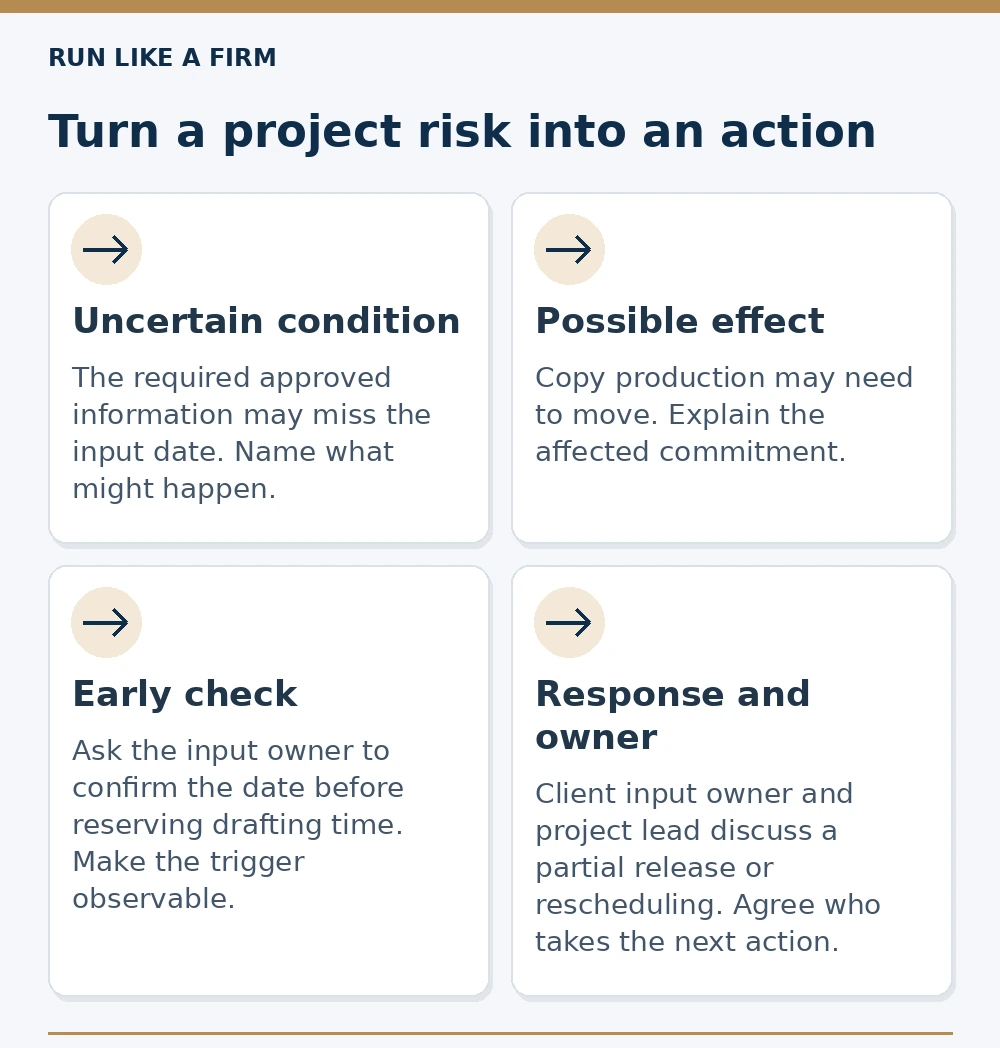
Read the decision map as text
- Uncertain condition: The required approved information may miss the input date. Name what might happen.
- Possible effect: Copy production may need to move. Explain the affected commitment.
- Early check: Ask the input owner to confirm the date before reserving drafting time. Make the trigger observable.
- Response and owner: Client input owner and project lead discuss a partial release or rescheduling. Agree who takes the next action.
Fictional example: approved product information may arrive late. Once the date is actually missed, manage the issue; do not keep treating it as a future risk.
Use a small worked risk list
Hypothetical website project, reviewed October 29, 2026. Keep one entry per uncertainty. The three entries below retain the original risks while adding evidence, triggers, status and residual exposure. Dates/times use America/New_York.
| Risk / condition, evidence and consequence | Trigger, response and owner | Status, review date and residual risk |
|---|---|---|
| R1: approved product facts may arrive late. The input owner has not confirmed the November 2, 3:00 p.m. handoff. Drafting may need to move. | Trigger: input owner cannot confirm at the October 30 checkpoint, or the agreed input date is missed. Project lead requests a revised input date; client input owner supplies it. Assess independent work, partial release or rescheduling before promising a new final date. | Open. Review October 30, 3:00 p.m. Even with a confirmed date, approval can still slip; retain an input check before drafting. |
| R2: external integration may not support the required booking route. Documentation omits that scenario. Full implementation could fail or require different work. | Trigger: the agreed technical check fails or cannot run because access is missing. Technical lead records the result; project lead offers an alternate route, narrower release or pause for authorization. | Investigating. Review November 2, 11:00 a.m. A successful limited test leaves other routes and environment changes untested. |
| R3: final approver may be unavailable at launch. Their confirmed leave overlaps the November 16 review. Acceptance could be delayed. | Trigger: no authorized backup is confirmed by November 6, noon. Client decision owner confirms delegation or agrees a revised review date with the project lead. | Response pending. Review November 6, noon. A named backup still needs authority, document access and enough review time. |
The owner is accountable for the next action, not for controlling every event. A descriptive probability field is optional when you have a defensible basis; no numerical probabilities or multiplied scores are implied here.
Prioritize by consequences and the opportunity to respond
You rarely have reliable numerical probabilities for a one-off client project. Use supported qualitative judgments and explain their basis.
Consider:
- How serious would the consequence be?
- Is there evidence that the condition is plausible here?
- When would you discover it?
- Can a low-cost check or adjustment reduce the exposure?
- How reversible is the decision you are about to make?
For example, a possible incompatibility deserves attention before an expensive implementation even if you cannot quantify its likelihood. A minor naming preference may wait because it is easy to change later.
Avoid multiplying arbitrary numbers and presenting the result as a probability of project failure. A priority label can help organize attention; it does not become a validated forecast merely because it has a formula.
Choose a response that matches the risk
You can change the plan to avoid a risk, reduce its likelihood or impact, arrange an appropriate transfer of some responsibility, or accept the remaining exposure with a conscious plan.
For a freelancer, practical responses might include a bounded technical test, a smaller first release, a verified backup reviewer, or a production sequence that does not depend on an unconfirmed input.
Do not assume that putting a responsibility in a contract eliminates the practical risk. A client may remain responsible for content while late content still affects your schedule. The project needs a delivery response as well as clear responsibilities.
Contractual protections, insurance, and payment terms require arrangements suitable for your circumstances. This article provides project-planning guidance, not a legal assessment of those protections.
Keep a risk from becoming an unsupported delivery promise
Consider the fictional integration risk. A technical check can produce three different results:
| Check result | Project decision |
|---|---|
| The agreed scenario works under the checked conditions | Proceed with those conditions recorded |
| The scenario fails | Assess another route, a smaller release, or stopping that part of the work |
| The check cannot be completed because access is missing | Keep the commitment provisional and request the access needed |
The third result is not a pass. It is also not proof the integration is impossible.
If you choose to proceed with an unresolved risk, state what is being accepted, who authorized that decision, and which response remains available. Do not bury the uncertainty in an internal note while presenting a fixed outcome to the client.
A successful limited check also does not prove every edge case works. Record what was checked and revisit the risk if the requirements or environment change.
Define the trigger for action
A risk response is easier to use when you know when to activate it.
Examples:
- If required access is not available before the technical check, do not confirm the implementation date yet.
- If the approver's absence is confirmed, obtain an authorized backup or revise the review sequence.
- If agreed inputs miss the review checkpoint, discuss the affected milestone before the client expects it to be complete.
These triggers are decisions tied to project facts, not universal numeric thresholds.
Reassess when the project changes
Review relevant risks at transitions: kickoff, major approvals, integration work, release, and handoff. Revisit the list when a new requirement, stakeholder, or dependency appears.
Close risks that no longer apply. Keeping resolved items marked urgent makes the list harder to trust.
When a risk becomes an issue, record what happened, the effect on the current commitments, and the action underway. Do not leave it described as a hypothetical concern while the work is already blocked.
Update the same entry when the risk becomes an issue
Continuation of fictional R1: on November 2 at 3:00 p.m., approved product facts are absent. Change the status to Issue — drafting blocked; link the missed handoff and identify the affected drafting milestone. Do not keep saying the input “may be late.”
On November 3, the client input owner confirms November 5 delivery. The project lead assesses a partial release against a revised schedule. The authorized client sponsor accepts that revised boundary and the remaining timing exposure in a dated decision record; the provider confirms it is feasible within available capacity. This accepts the stated residual risk, not every possible consequence.
Record the decision, revised milestones, owner and next review on November 5. Independent approved work may continue, but drafting that depends on unapproved facts waits. Close the issue only after the required facts are received and checked; continue monitoring the residual schedule exposure.
A client project update can explain a material risk and the next checkpoint without sharing an unexplained internal list.
Give risk ownership a place in the service business operating system so the next action remains visible.
Communicate without making every uncertainty sound like a crisis
Tell the client what the concern means for their project and what decision is needed. Avoid sending a long internal risk list with no explanation of priorities.
For example:
The integration test is not yet complete, so the launch date remains provisional. I will confirm the result Thursday. If the required scenario is unsupported, we will choose between a different connection method and a narrower first release.
That communicates uncertainty honestly without claiming the project is doomed.
Learn from the engagement
At closeout, ask which assumptions proved wrong, which signals were useful, and which responses were excessive or missing. Improve your own planning checklist from actual observations.
One avoided problem does not establish a percentage reduction in risk. A small number of projects cannot support precise forecasting. You can still learn which checks were worth performing.
For your next engagement, identify three material uncertainties and write the signal and action for each. Add more only where they can improve a real decision.