
A rejected or stalled freelance proposal can reflect an unclear recommendation, a mismatch, an unavailable budget, a blocked decision, or a better-fitting alternative. The outcome alone does not tell you which explanation applies.
Before changing the design or lowering the fee, establish whether the buyer needs clarification, different scope, a later decision point, or no further pursuit. A well-written proposal can still lose for reasons outside your control.
Identify what “failed” means
Different outcomes require different responses:
- No reply: the client has not responded within the expected window.
- No decision: the project remains open, but nobody has committed to an option.
- Explicit rejection: the client has declined your offer.
- Different selection: the client chose another provider or an internal solution.
- Project cancellation: the work itself is no longer proceeding.
Do not record all five as “price objection.” If you do not know the reason, record it as unknown. That preserves the difference between evidence and a convenient explanation.
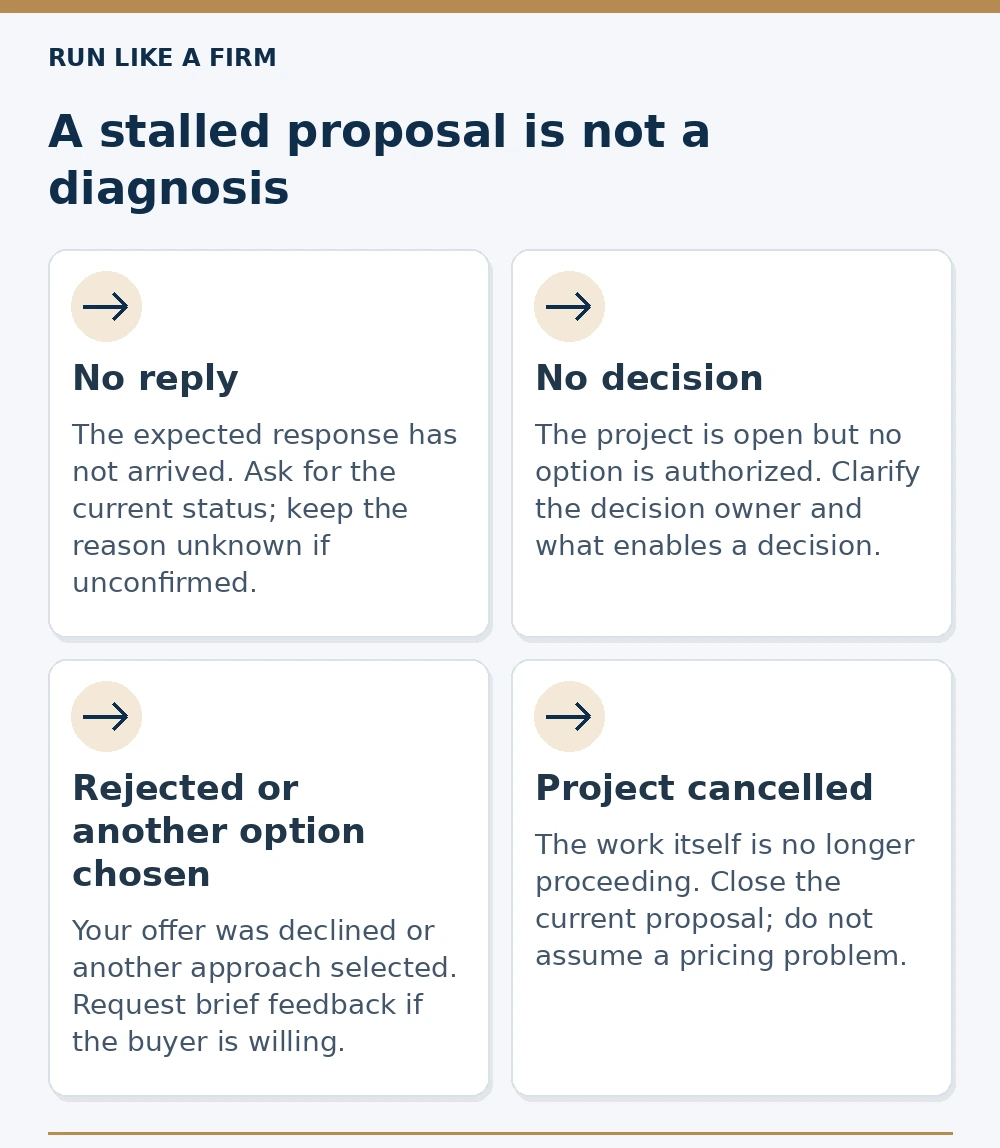
Read the decision map as text
- No reply: The expected response has not arrived. Ask for the current status; keep the reason unknown if unconfirmed.
- No decision: The project is open but no option is authorized. Clarify the decision owner and what enables a decision.
- Rejected or another option chosen: Your offer was declined or another approach selected. Request brief feedback if the buyer is willing.
- Project cancelled: The work itself is no longer proceeding. Close the current proposal; do not assume a pricing problem.
Record what happened before guessing why it happened. Change scope, price, or presentation only when the evidence supports that response.
Check the issue before choosing the repair
| Signal | Possible explanation—not a diagnosis | Useful next question or action |
|---|---|---|
| Client keeps asking what is included | Scope or wording may be unclear | Ask which requirement they cannot locate; revise that section |
| Client asks to reduce the fee | Budget, perceived value, competing offers, or negotiation | Ask what budget or scope constraint they are working with |
| Contact likes the proposal but cannot proceed | Authorization or stakeholder concerns | Clarify who must decide and what information they need |
| Decision date repeatedly moves | Priorities, procurement, uncertainty, or low urgency | Ask whether the project is still active and what event enables a decision |
| Client chooses another provider | Relevant experience, delivery fit, price, trust, or another factor | Ask for brief feedback if they are willing to share it |
| Client stops replying | Many explanations remain possible | Send a concise status question; do not infer motive from silence |
A follow-up should resolve uncertainty, not pressure the client to validate your theory.
Where the work lacks a supported rationale, revisit the problem-diagnosis process rather than only editing the pitch.
Revisit the work you proposed
Can you explain how the proposed work addresses the established problem? If the document simply repeats a requested deliverable, the client may struggle to understand why your approach is appropriate.
For a fictional example, a client asks for an onboarding automation. Your proposal lists forms, emails, and integrations, but nobody has identified where onboarding breaks down. Rewriting the fee table will not resolve that missing diagnosis.
The next step could be to examine a few recent onboarding journeys and then narrow the work. It could also reveal that the client already has suitable software and needs a clearer operating process.
Keep the response proportionate. You do not need to reopen every aspect of discovery because one sentence in the proposal was unclear.
Check whether the client can make a decision
A proposal can be understandable and still have nowhere to go.
Before investing in another version, establish whether the project has an owner, an authorization path, and a realistic decision window. An internal sponsor can be valuable, but they may need material for a budget holder or procurement review.
Ask:
What needs to happen internally before you can decide, and is there information I can provide to support that step?
If the answer is “We will revisit this next quarter,” record that timing. Repeated weekly persuasion may not help either side.
Treat pricing feedback as information
“Too expensive” is not a complete diagnosis. Clarify whether the client means the fee exceeds an approved budget, the scope is larger than needed, or the value is not convincing compared with alternatives.
Different answers lead to different actions:
- Reduce the scope if a smaller useful result fits the budget.
- Explain a misunderstood inclusion or responsibility.
- Offer a paid assessment if uncertainty makes a large commitment unsuitable.
- Hold the price when the defined work cannot be delivered responsibly for less.
- Decline when no workable arrangement exists.
Do not remove essential work while keeping the original promise. And do not manufacture ROI figures to defend a price.
Send a follow-up that permits an honest answer
For example:
Hi Jordan, we had planned to review the proposal this week. Is the project still moving forward on that timeline? If a scope or approval question is holding the decision, please let me know which one. If priorities have changed, I can close the current proposal and revisit it when the project is active.
One contextual sequence: for a direct-client proposal sent October 27, 2026 with an agreed November 2 review, send the status question November 3 if no decision arrives. If the sponsor then names the November 10 budget review, record it and agree to reconnect November 11; do not keep sending weekly persuasion in between. If they explicitly decline, acknowledge and close instead. If silence continues after a proportionate follow-up, stop holding availability under your actual arrangements and use the closing message below. These dates are an example, not a universal number or cadence.
If you need an answer to manage availability, state the genuine scheduling consequence. Do not create fake urgency or claim that a slot has disappeared unless that is true.
After an explicit decline, acknowledge it. One optional feedback question is enough; the client does not owe you a detailed loss analysis.
Know when to close the current proposal
Continued follow-up needs a reason. Ask whether the project is active, whether there is a decision path, and whether the next contact could resolve a specific question.
If the buyer gives a future review date, record it and agree when to reconnect. If they explicitly decline, close the proposal. If they remain silent after your proportionate follow-up, you can stop holding availability while leaving the door open.
For example:
I have not received a decision, so I am closing this proposal for scheduling purposes. If the project becomes active, please get in touch. I will reconfirm the scope, fee, and availability before we proceed.
Use that wording only if it reflects your actual arrangements. Closing a proposal record does not by itself cancel an agreement or change any obligation already accepted.
There is no universal number of follow-ups that makes a lead worth pursuing. Use the buying context and your commitments, then keep the reason for closing separate from a guessed reason for the client's silence.
If the objection is a request for a lower fee, use the guide to handle client discount requests before rewriting the proposal.
Separate marketplace advice from direct-client proposals
A marketplace application introduces you for a hiring decision. A direct-client project proposal presents a particular engagement, often after discovery. Assess the actual decision stage before applying a tactic from one setting to the other.
A direct-client project proposal may instead follow weeks of conversation and involve budgets, stakeholder approval, or procurement. Do not assume an Upwork cover-letter tactic will repair that buying process.
Likewise, do not judge an application that never received a reply by the same standard as a proposal reviewed by an authorized project owner.
If feedback identifies a document problem, repair the relevant part of the project proposal.
Learn from losses without inventing a pattern
Record the outcome, any reason the buyer actually supplied, the source of that information, and what you would change next time.
Keep your interpretation separate. “Buyer said launch was postponed” is evidence. “Our proposal was too long” may be a hypothesis unless they said so or you have other support.
Proposal date / service and client type:
Value / currency:
Outcome / review date:
Confirmed reason:
Source / source date:
Suspected reason (unconfirmed):
Pending status / decision event:
Action / owner / next review:
Three opportunities with different evidence
Hypothetical records reviewed November 6, 2026. Amounts describe illustrative proposed fees, not earned revenue.
| Proposal / service / value | Outcome and confirmed reason | Source and suspected reason | Pending status / action |
|---|---|---|---|
| October 20: editing for a consultancy; USD 1,500 | Lost: buyer says the launch is postponed and declines the current offer. | Buyer’s email October 28. No additional reason inferred; price is not identified as the cause. | Closed current offer. Freelancer records the buyer’s requested January review, without holding a production slot or changing the fee speculatively. |
| October 22: website copy for a studio; USD 3,000 | Lost: buyer says another provider was selected. The selection reason is unknown. | Buyer’s email October 30; no response to the optional feedback question. “Our proposal was too long” remains an unsupported suspicion. | Closed, not pending. Freelancer keeps the reason unknown; no wholesale rewrite is justified by this record. |
| October 27: inquiry workflow for a small agency; USD 2,500 | Pending, not a loss. No rejection reason exists. | Sponsor’s November 3 message says budget-holder review is planned November 10. Suspected price resistance is unconfirmed. | Freelancer confirms whether approval material is needed and reviews after November 10. The event is authorization, not another redesign of the proposal. |
If later feedback identifies a specific missing inclusion, repair the scope section of the proposal. If it identifies an unworkable budget, revisit scope and price alignment. An unknown reason justifies a question or a restrained review, not a fabricated diagnosis.
Review comparable proposals together. A single loss is a weak basis for changing your entire service, price, or positioning. Repeated feedback from suitable buyers is more useful, particularly when it points to the same specific issue.
For the next stalled proposal, choose one question that would change your action. Ask it before redesigning the document. Better proposals start with better information, but winning every engagement is neither possible nor the right objective.